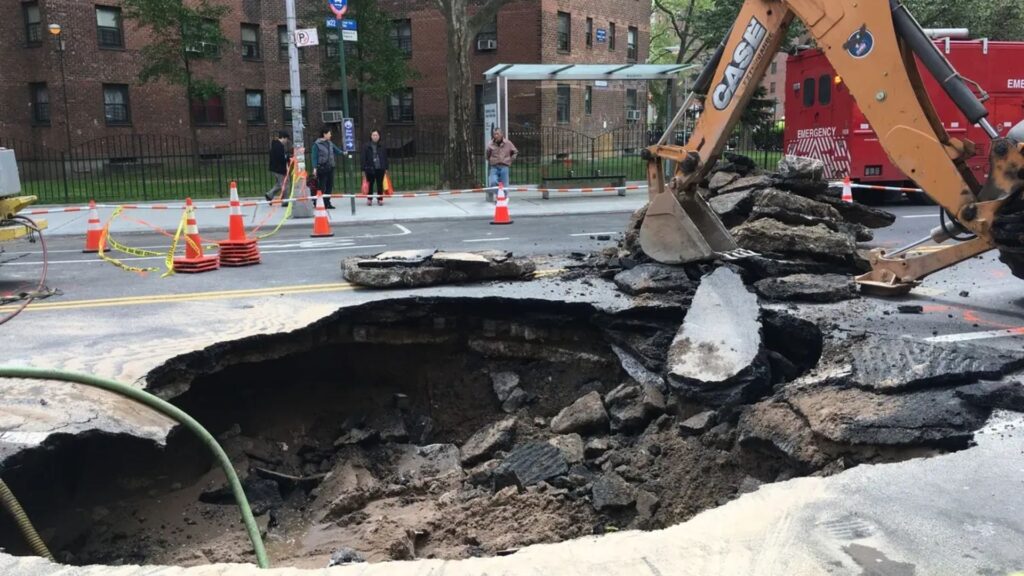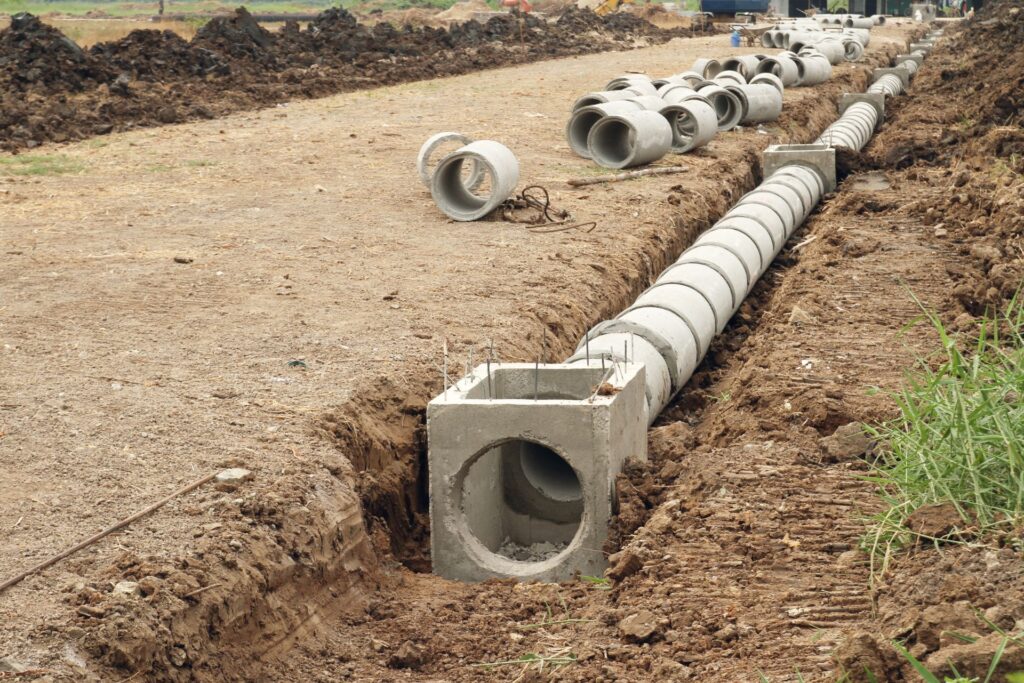
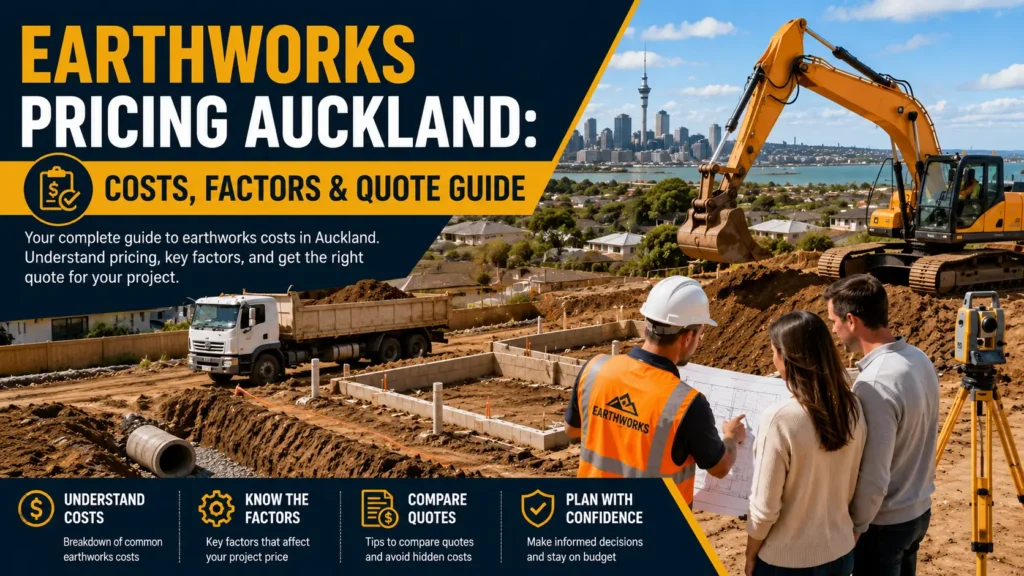
Welcome to our guide on earthworks pricing in Auckland, where you will learn what excavation and site preparation may cost, which factors influence the final price, and how contractors calculate quotes. Whether you are planning a driveway, foundation, retaining wall, pool, drainage project, or landscaping work, this guide will help you understand common charges, avoid hidden costs, compare contractors, and prepare a realistic budget before work begins.
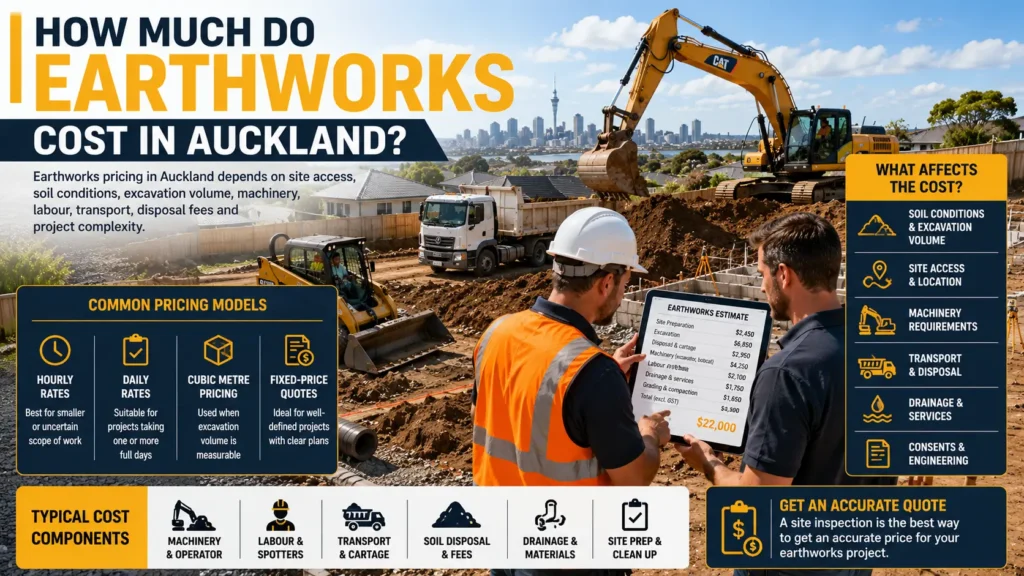
Earthworks pricing in Auckland depends on site access, soil conditions, excavation volume, machinery, labour, transport, disposal fees, drainage, and project complexity. Contractors may charge hourly, daily, by cubic metre, or by fixed quote. A site inspection is the best way to receive an accurate price.
Table of Contents
How Much Do Earthworks Cost In Auckland?
Understanding earthworks pricing in Auckland can help you plan your budget and compare quotes with greater confidence. There is no single price that applies to every project because each site presents different challenges. Factors such as excavation depth, soil type, machinery requirements, access restrictions, drainage needs, and the amount of material that must be removed all influence the final cost. A small residential excavation may require only a mini excavator and a few hours of work, while a large site-cut for a new home can involve multiple machines, truck movements, engineering input, and several days of excavation.
Earthworks contractors use different pricing methods depending on the scope and complexity of the project. Understanding how each pricing model works makes it easier to interpret quotes and identify exactly what you are paying for.
- Hourly rates: Often used for smaller projects or work where the exact duration cannot be predicted, such as clearing a site, trenching, or minor excavation.
- Daily rates: Suitable for projects expected to take one or more full working days where machinery and operators remain on-site throughout the project.
- Cubic metre pricing: Common when the amount of soil or rock being excavated can be accurately measured before work begins.
- Square metre pricing: Sometimes used for large-scale site preparation, levelling, or surface grading where the work area is clearly defined.
- Fixed-project quotes: Frequently provided for residential projects with well-defined plans, allowing homeowners to understand the expected total cost before work starts.
When comparing prices, remember that advertised rates rarely represent the total project cost. Many published rates only cover machinery and the operator, while additional services are charged separately.
These additional costs may include:
- Soil disposal: Removing excavated material to an approved disposal facility.
- Transport: Delivering machinery, trucks, and equipment to and from the site.
- Additional labour: Extra workers required for traffic control, spotting, drainage installation, or manual excavation.
- Site preparation: Vegetation removal, demolition, marking underground services, and clearing obstacles before excavation begins.
- Imported materials: Clean fill, topsoil, drainage aggregate, or basecourse supplied after excavation.
- Specialist services: Engineering advice, contaminated soil handling, or erosion-control measures where required.
A detailed written quote should clearly separate these costs so you can compare contractors fairly and avoid unexpected variations once work begins.
Typical Hourly Earthmoving Rates
Hourly pricing is one of the most common charging methods for smaller earthworks projects because it provides flexibility when site conditions are uncertain. If the amount of excavation cannot be accurately estimated before work starts, charging by the hour allows contractors to adjust as the project progresses.
The hourly rate usually depends on the size of the equipment, the experience of the operator, and whether additional machinery or labour is required.
Excavator Hire With an Operator
Excavators are used for a wide range of earthmoving tasks, including site cuts, foundation excavation, trenching, landscaping, and retaining wall preparation. The hourly rate generally includes both the excavator and an experienced operator.
Larger excavators usually cost more because they consume more fuel, require larger transport vehicles, and can complete heavier excavation work. Smaller machines may appear less expensive, but they can take longer to complete larger projects if the site allows for bigger equipment.
Bobcat and Skid-Steer Hire
Bobcats and skid-steer loaders are well suited to confined residential sites where larger machinery cannot easily operate. They are commonly used for moving soil, spreading basecourse, site clean-up, and final grading.
These machines are often hired alongside excavators to improve productivity. Using both machines together can reduce manual handling and shorten the overall project duration.
Truck and Trailer Charges
Excavated material must often be transported away from the property. Truck charges generally cover loading, travel time, disposal runs, and return trips.
Projects involving large excavation volumes may require multiple truck movements throughout the day. Disposal costs can increase significantly when material must be transported over longer distances or taken to specialist disposal facilities.
Labour and Spotter Costs
Some projects require more than a machine operator. Additional workers may be needed to guide machinery in confined spaces, manage traffic, install drainage components, or assist with manual excavation around existing services.
Spotters also improve safety by monitoring blind spots and helping operators work safely near buildings, fences, underground utilities, and pedestrians.
Minimum Booking Periods
Many contractors apply minimum booking periods because transporting heavy machinery involves significant setup time and cost. Even relatively small jobs may have a minimum charge regardless of whether the excavation takes only a short time to complete.
Before accepting a quote, ask whether the minimum booking includes:
- Machine transport: Delivery and collection of equipment.
- Operator time: Travel, setup, and operating hours.
- Fuel costs: Whether fuel is included in the hourly rate.
- Standby time: Charges if work pauses because of weather or site delays.
- Site cleanup: Basic cleanup after excavation is complete.
Understanding these details helps prevent confusion when the final invoice is issued.
Fixed-Price Earthworks Quotes
Many homeowners prefer a fixed-price quote because it provides greater certainty before construction begins. Instead of paying for the number of hours worked, the contractor agrees to complete an agreed scope of work for a single price.
Fixed pricing works best when the project has been carefully planned and the site has already been inspected.
When Contractors May Offer a Fixed Price
A contractor is more likely to provide a fixed quote when there is enough information to accurately estimate labour, machinery, materials, and disposal costs.
Examples include:
- New-home site preparation: Approved building plans clearly define excavation levels.
- Driveway excavation: Dimensions and finished levels are already known.
- Retaining wall excavation: Engineering drawings specify excavation requirements.
- Pool excavation: Pool dimensions and excavation depth are confirmed.
- Landscaping projects: Finished contours and site plans have been finalised.
The more information available before work begins, the more accurate a fixed quote can be.
What a Fixed Quote Should Include
A professional quote should clearly explain exactly what is included within the agreed price.
Look for details such as:
- Excavation work: Scope of earth removal and site preparation.
- Machinery: Equipment that will be supplied.
- Labour: Number of operators and workers included.
- Material removal: Disposal of excavated soil and waste.
- Imported materials: Any fill, aggregate, or topsoil included in the project.
- Site reinstatement: Levelling, compaction, or final cleanup after excavation.
- Project timeline: Estimated start and completion dates.
- Payment terms: Deposit requirements and progress payments if applicable.
The more detailed the quote, the easier it is to compare competing contractors on equal terms.
Why Provisional Allowances May Still Apply
Even with a fixed-price contract, some unknown conditions cannot be confirmed until excavation begins. Contractors often include provisional allowances to account for these uncertainties while keeping the overall quote as accurate as possible.
Common examples include:
- Rock excavation: Solid rock may require specialised breaking equipment.
- Contaminated soil: Disposal costs can increase if contaminated material is discovered.
- Underground obstructions: Old foundations, buried concrete, tree roots, or abandoned pipes may require additional work.
- Groundwater: Unexpected water may require pumping or drainage improvements.
- Additional disposal: Excavated material can expand once removed, increasing transport requirements.
A reputable contractor will explain when provisional allowances may apply and discuss any changes before carrying out additional work.
Situations Where Fixed Pricing May Not Be Practical
Some projects involve too many unknown variables to provide an accurate fixed price. In these situations, hourly or daily rates may be a fairer pricing method for both the contractor and the property owner.
Examples include:
- Poorly defined projects: Final excavation levels have not yet been confirmed.
- Uncertain ground conditions: Soil composition cannot be accurately assessed before excavation.
- Emergency excavation: Urgent work must begin before full investigations can be completed.
- Large-scale rural sites: Excavation quantities may change as work progresses.
- Complex demolition projects: Hidden structures or underground obstacles may significantly alter the scope of work.
Discussing these uncertainties during the quoting process helps establish realistic expectations and reduces the likelihood of unexpected costs later.
Understanding how earthworks contractors calculate pricing allows you to compare quotes more effectively and choose the option that offers the best overall value rather than simply the lowest advertised price. A detailed site inspection and a transparent written quote remain the most reliable way to budget accurately and avoid costly surprises during excavation.
What Is Usually Included In An Earthworks Quote?
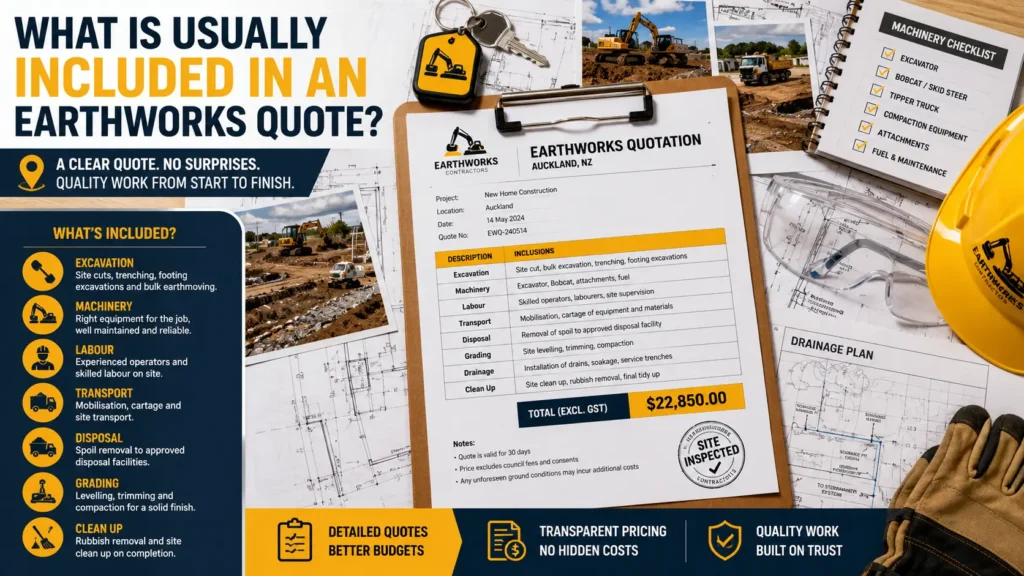
A detailed earthworks quote should clearly explain what work is covered and what services are included in the price. While every contractor prepares quotes differently, most professional earthworks companies include the core tasks needed to complete the excavation and site preparation safely and efficiently. Understanding these inclusions makes it easier to compare quotes, avoid unexpected costs, and ensure your project starts with realistic expectations.
Site Inspection
A site inspection is often the first step in preparing an accurate earthworks quote. Rather than estimating costs from photos or rough measurements, an experienced contractor will visit the property to assess conditions that could affect pricing and project planning.
During the inspection, the contractor may evaluate:
- Site access: Whether excavators, trucks, and other machinery can safely reach the work area.
- Ground conditions: The type of soil, slope, drainage, and any visible rock or unstable ground.
- Existing structures: Nearby buildings, fences, retaining walls, trees, or underground services that require protection.
- Project requirements: The excavation depth, finished levels, and any special construction requirements.
A thorough inspection helps reduce pricing surprises and allows the contractor to recommend the most suitable equipment for the job.
Machinery and Operator
Most earthworks quotes include the machinery required to complete the project along with a qualified operator. The equipment selected depends on the size of the excavation, available access, and the nature of the work.
The quote may include:
- Excavators: For digging, trenching, and bulk earthmoving.
- Skid-steers or bobcats: For confined spaces and material handling.
- Loaders: For moving soil, gravel, or other materials around the site.
- Compaction equipment: To prepare stable surfaces for construction.
- Experienced operators: Skilled professionals who safely operate the machinery and complete excavation accurately.
Using appropriately sized equipment improves productivity while reducing unnecessary labour and equipment costs.
Excavation or Site Cutting
Excavation is usually the primary component of an earthworks project. This involves removing soil to achieve the required depth, shape, or foundation level shown on the project plans.
Depending on the project, excavation may include:
- Preparing house foundations
- Cutting building platforms
- Excavating for driveways
- Creating pool excavations
- Digging drainage trenches
- Forming retaining wall foundations
The complexity of excavation often depends on soil conditions, excavation depth, and the amount of material that needs to be removed.
Soil Movement
Not all excavated soil leaves the property. Many projects involve moving material from one area of the site to another to improve levels or prepare different construction areas.
This may include:
- Building platforms: Relocating soil to create level building areas.
- Landscaping: Filling low sections of the property.
- Backfilling: Placing suitable material behind retaining walls or around foundations.
- Site balancing: Redistributing soil to reduce disposal costs.
Reusing suitable material on-site can often improve project efficiency while reducing transport and disposal expenses.
Basic Levelling and Grading
Once excavation has been completed, contractors commonly carry out basic levelling and grading to prepare the site for the next stage of construction.
This work may involve:
- Creating even building surfaces
- Establishing correct falls for drainage
- Preparing driveways
- Smoothing landscaped areas
- Removing minor high spots
Proper grading helps manage stormwater and creates a stable foundation for future building work.
Loading Excavated Material
Where material needs to be removed from the property, the quote generally includes loading excavated soil into trucks using excavators or loaders.
The loading process typically covers:
- Efficient stockpile management
- Safe loading procedures
- Separating reusable material from waste
- Preparing loads for transport
Efficient loading reduces machinery idle time and helps keep the project on schedule.
Transport Within the Site
Large construction sites often require material to be transported from one work area to another before final placement.
Examples include:
- Moving fill to different building platforms
- Relocating topsoil for later landscaping
- Transporting aggregate to access roads
- Moving spoil to temporary storage areas
Internal transport may be completed using dumpers, loaders, or trucks depending on site size and terrain.
Cleanup
Professional contractors generally include a basic site cleanup once excavation work has been completed. Although this is not a final landscaping service, it leaves the work area safe and ready for the next trade.
Cleanup commonly includes:
- Removing loose debris
- Collecting excess materials
- Tidying machinery access routes
- Leaving excavation areas in a safe condition
A clean site helps prevent delays and allows following trades to begin work more efficiently.
Costs That May Be Listed Separately
Although many essential services are included in an earthworks quote, some costs are often itemized separately because they depend on site conditions, regulatory requirements, or the final project scope. Reviewing these items carefully helps you understand the true cost of the project before work begins.
Soil and Waste Disposal
Disposal costs are frequently listed separately because they vary depending on both the volume and type of material removed.
Additional charges may apply for:
- Clean soil: Material suitable for approved clean-fill facilities.
- Mixed waste: Soil containing concrete, bricks, timber, or construction debris.
- Contaminated material: Soil requiring specialist handling and disposal.
- Transport distance: Longer travel times increase trucking costs.
If disposal is not clearly included, ask your contractor how these costs will be calculated if additional material must be removed.
Clean Fill Delivery
Some projects require imported fill to replace excavated soil or raise site levels after excavation.
The final cost depends on:
- Material volume: The quantity of fill required.
- Material quality: Engineered fill may cost more than standard clean fill.
- Delivery distance: Transport costs increase with travel time.
- Site access: Difficult access may require smaller delivery vehicles.
Imported fill should meet the project specifications to ensure long-term stability.
Aggregate and Basecourse
Driveways, foundations, and paved surfaces often require compacted aggregate before construction can continue.
Separate pricing may include:
- Basecourse supply: Crushed rock used to build stable foundations.
- Drainage aggregate: Material placed around drainage systems.
- Compaction: Preparing the aggregate to meet construction standards.
- Additional thickness: Extra material needed for weak ground conditions.
The quantity required depends on engineering requirements and the intended use of the finished surface.
Drainage Materials
Drainage systems are critical for protecting buildings, retaining walls, and landscaped areas from water damage.
Separate charges may include:
- Drainage pipes: Stormwater collection and discharge systems.
- Filter fabric: Material used to reduce sediment movement.
- Drainage gravel: Aggregate that allows water to flow freely.
- Inspection pits: Access points for future maintenance.
Proper drainage is often one of the most important long-term investments within an earthworks project.
Traffic Management
Projects located beside busy roads or public spaces may require formal traffic management to protect workers, pedestrians, and motorists.
This may include:
- Traffic controllers: Qualified personnel directing vehicles.
- Temporary signage: Advance warning signs for approaching traffic.
- Lane management: Temporary road adjustments where required.
- Safety barriers: Protection around work zones.
Traffic management requirements are usually determined by local regulations and the location of the worksite.
Council Permits
Some earthworks projects require permits or approvals before work can begin.
Separate permit-related costs may cover:
- Application fees: Charges payable to the local authority.
- Processing costs: Administrative review of the application.
- Inspection fees: Council inspections during construction.
- Compliance documentation: Records confirming approval requirements have been met.
Permit requirements vary depending on the size, location, and nature of the project.
Utility Locating
Before excavation begins, underground utilities should be identified to reduce the risk of accidental damage.
Utility locating may involve:
- Water services: Identifying underground water pipes.
- Gas lines: Confirming gas infrastructure locations.
- Electrical cables: Detecting buried power services.
- Telecommunications: Locating fibre and communication networks.
Identifying utilities before excavation improves both safety and project efficiency.
Engineering Advice
Some projects require engineering input to verify excavation methods or structural requirements.
Engineering services may include:
- Geotechnical advice: Assessing soil conditions and stability.
- Structural design: Reviewing retaining walls or foundation support.
- Site-specific recommendations: Providing construction guidance based on local conditions.
- Compliance documentation: Reports required for approvals or inspections.
Engineering advice helps reduce construction risks on more complex sites.
Retaining Systems
Excavation on sloping land or near existing structures may require temporary or permanent retaining systems.
These may include:
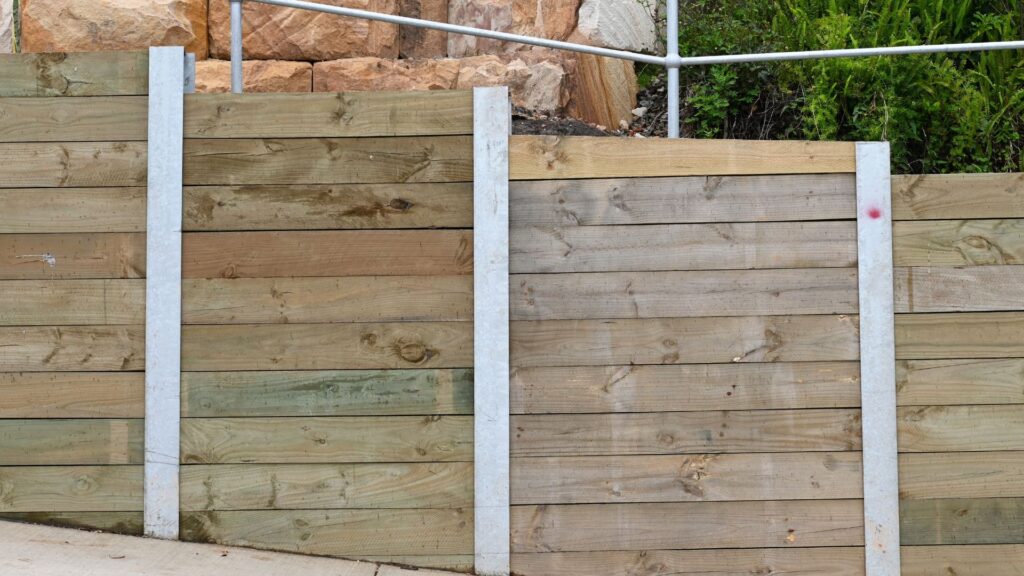
- Timber retaining walls: Suitable for many residential applications.
- Concrete retaining structures: Used for higher load requirements.
- Temporary support systems: Protecting excavation faces during construction.
- Drainage integration: Preventing water pressure behind retaining structures.
Retaining requirements depend on excavation depth, soil stability, and nearby structures.
Site Remediation
Unexpected site conditions can sometimes require additional work before construction proceeds.
Examples include:
- Contaminated soil removal: Safe disposal of affected material.
- Ground stabilization: Improving weak or unstable soil.
- Vegetation removal: Clearing invasive roots or unwanted growth.
- Environmental compliance: Meeting site-specific environmental requirements.
Addressing these issues early helps reduce future construction risks and improves the long-term performance of the completed project.
A detailed earthworks quote should clearly separate included services from additional costs so you know exactly what you are paying for before construction begins. Taking the time to review each item carefully and asking questions about anything that is unclear can help you compare contractors more accurately, avoid unexpected expenses, and move forward with greater confidence.
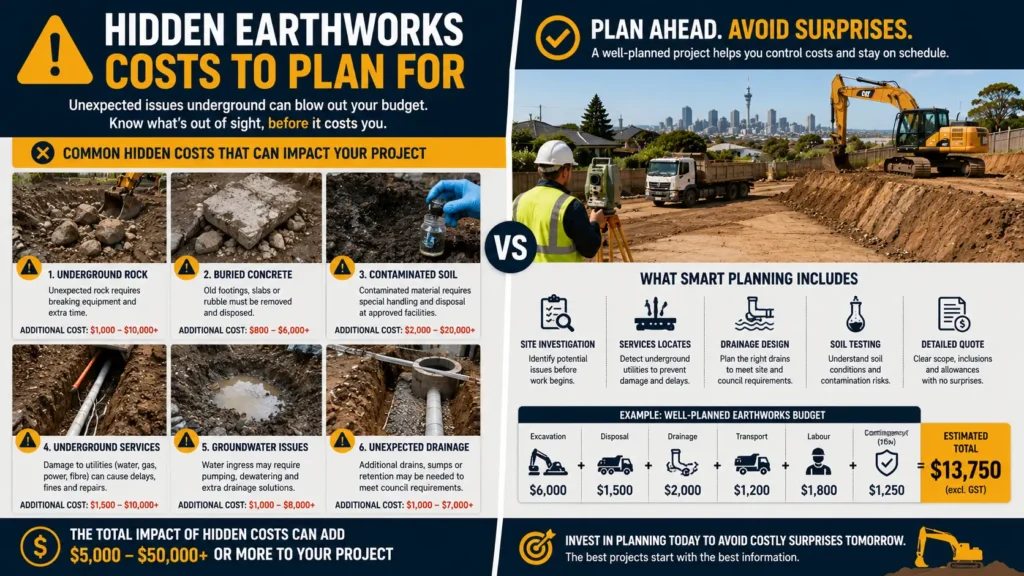
Main Factors That Affect Earthworks Pricing In Auckland
No two earthworks projects are exactly the same, even if they appear similar at first glance. One site may be completed quickly with minimal excavation, while another may require additional machinery, drainage work, or specialist engineering because of difficult ground conditions or limited access. Understanding the factors that influence pricing helps you compare quotes more accurately and reduces the risk of unexpected costs once work begins.
Site Access
Site access is one of the first things an earthworks contractor will assess during a site visit. Easy access allows machinery and trucks to work efficiently, while restricted access can increase labour time, require smaller equipment, or involve additional planning.
- Narrow driveways: Tight entrances may prevent larger excavators and tip trucks from reaching the work area. Smaller machines often need more time to complete the same amount of work, which can increase labour and equipment costs.
- Steep sections: Sloping sites require extra care to maintain stability and ensure machinery can operate safely. Additional excavation stages, benching, or temporary support measures may be needed before work can continue.
- Limited turning space: Trucks and heavy equipment need enough room to manoeuvre safely. If vehicles must reverse long distances or make multiple movements, the project may take longer to complete.
- Overhead power lines: Power lines can restrict the height and movement of excavators and trucks. Contractors may need to adjust equipment selection or working methods to maintain safe clearance.
- Restricted working hours: Some residential areas or commercial sites limit the hours when construction work can take place. Shorter working windows can extend the overall project timeline and affect scheduling costs.
- Need for smaller machinery: Compact excavators are valuable for confined spaces, but they usually move less material per cycle than larger machines. Although they improve access, they may increase the total operating time.
Soil and Ground Conditions
The condition of the ground plays a major role in determining both the difficulty and cost of excavation. While some sites contain stable soil that is easy to work with, others may present challenges that require specialised equipment or additional engineering.
- Clay-heavy soil: Much of Auckland contains clay-rich ground, which becomes heavy and difficult to excavate when wet. Clay can also stick to machinery and increase loading and transport times.
- Rock: Solid rock often requires hydraulic rock breakers or specialised excavation equipment. Breaking rock is slower than digging soil and can significantly increase project costs.
- Soft or unstable ground: Weak ground may not support heavy machinery safely. Contractors may need to stabilise the area before excavation or use lighter equipment to reduce the risk of further ground movement.
- Saturated soil: Waterlogged ground slows excavation and may require pumping or temporary drainage before machinery can operate efficiently. Wet soil is also heavier, increasing transport and disposal costs.
- Contaminated material: Soil contaminated by chemicals, fuel, asbestos, or other hazardous substances requires testing and disposal at approved facilities. Strict environmental regulations can increase both time and cost.
- Existing concrete or buried foundations: Old slabs, footings, retaining walls, and buried structures often require demolition before excavation can continue. Unexpected obstructions are a common reason projects exceed their original estimates.
Excavation Depth and Volume
The amount of material being removed has a direct impact on project pricing. Larger excavations require more machinery time, additional truck movements, and greater disposal costs.
- Total cubic metres removed: Contractors estimate the total volume of soil or rock to calculate equipment requirements, transport needs, and project duration.
- Depth of excavation: Deeper excavations may require additional safety precautions, staged digging, or engineered support depending on the surrounding ground conditions.
- Amount of material moved on-site: Not all excavated material leaves the property. Some projects involve relocating suitable soil to another part of the site for landscaping or backfilling, which can reduce disposal costs.
- Accuracy required for final levels: Projects such as house foundations, retaining walls, and driveways often require precise finished levels. Achieving these specifications may involve additional surveying, checking, and fine grading.
Machinery Requirements
The type and size of machinery used on a project affect both productivity and pricing. Contractors select equipment based on the site conditions, excavation volume, and access limitations.
- Mini excavators: Ideal for confined residential sites where access is limited. They minimise property damage but generally complete excavation more slowly than larger machines.
- Larger excavators: Suitable for bulk earthmoving and large commercial projects where productivity is the priority. Their higher operating costs are often offset by faster completion times.
- Bobcats: Commonly used for site clean-up, spreading fill, and moving materials over short distances. They are particularly useful after major excavation work has been completed.
- Compactors: Proper compaction is essential for creating stable foundations, driveways, and landscaped areas. Different compaction equipment may be required depending on soil type and project specifications.
- Rock breakers: Hydraulic breakers are used when excavation encounters solid rock or reinforced concrete. Their use usually increases project duration because breaking hard material is slower than standard excavation.
- Loaders: Wheel loaders efficiently move loose material around larger sites and assist with loading trucks where high production is required.
- Tip trucks: These vehicles transport excavated soil, rock, and demolition material to disposal facilities or bring imported fill to the site. The number of truck movements can significantly influence the final project cost.
Material Disposal
Removing excavated material is often one of the largest components of an earthworks budget. Disposal costs vary depending on the type of material and the distance it must travel.
- Clean soil disposal: Natural soil that is free from contamination is generally less expensive to dispose of and may sometimes be reused at approved sites.
- Mixed construction waste: Excavated material containing concrete, timber, bricks, or vegetation usually requires sorting before disposal, increasing labour and tipping costs.
- Contaminated soil: Hazardous material must be transported and disposed of at licensed facilities that comply with environmental regulations. Documentation and testing may also be required.
- Truck travel distance: Longer travel times reduce the number of loads that can be completed each day, increasing transport expenses.
- Disposal facility fees: Different facilities charge different tipping rates depending on the type and volume of material being accepted.
- Multiple truck movements: Large excavation projects often require numerous truckloads to remove spoil. More trips increase fuel consumption, labour hours, and vehicle operating costs.
Drainage and Water Management
Managing water effectively is an important part of many earthworks projects. Poor drainage can delay construction, affect soil stability, and create long-term problems if not addressed during excavation.
- Groundwater: Excavation below the natural water table may require ongoing pumping to keep the work area dry and safe.
- Stormwater control: Contractors often install temporary measures to prevent rainwater from washing sediment into neighbouring properties or public drainage systems.
- Temporary pumping: Water that collects in excavated areas may need to be removed continuously until permanent drainage is installed.
- Trench drainage: Service trenches and retaining wall excavations frequently require drainage systems to manage groundwater and reduce long-term pressure behind structures.
- Erosion protection: Silt fences, sediment barriers, and stabilisation methods help reduce environmental impacts during construction and may be required on certain sites.
- Wet-weather delays: Heavy rainfall can make excavation unsafe or damage prepared surfaces. Delays caused by poor weather may affect project schedules and machinery availability.
Project Location
The location of a project within the Auckland region can also influence earthworks pricing. Local ground conditions, traffic, access, and travel time all contribute to the final cost.
- Central Auckland access restrictions: Busy streets, limited parking, and traffic management requirements can increase setup time and operating costs for machinery and trucks.
- North Shore site conditions: Many properties feature sloping terrain and established residential areas where careful excavation and restricted access planning are necessary.
- West Auckland clay soils: Heavy clay is common in many western suburbs and often becomes difficult to excavate after prolonged rainfall, increasing machinery time.
- South Auckland development areas: New subdivisions may provide easier access for large equipment, although project requirements can vary depending on infrastructure and site preparation standards.
- Rural travel distances: Properties outside the main urban area may involve longer travel times for machinery, operators, and trucks, increasing mobilisation costs.
- Parking and traffic limitations: Restricted street parking, narrow roads, and busy traffic corridors can affect equipment delivery, truck movements, and overall project efficiency.
Understanding these pricing factors makes it much easier to compare earthworks quotes and identify what each contractor has included. A detailed site inspection remains the best way to uncover potential challenges early, allowing you to budget more accurately and choose a solution that matches both your project requirements and your long-term goals.
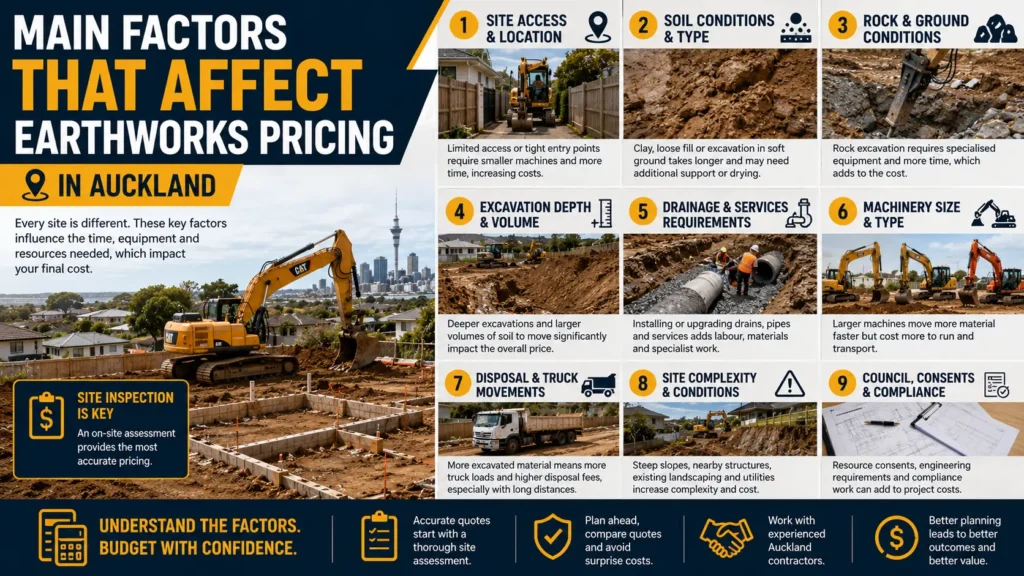
Earthworks Cost Estimates By Project Type
Every earthworks project is different, so there is no single price that applies to every site. The examples below should be treated as planning categories rather than guaranteed prices. The final cost will depend on factors such as site access, excavation volume, soil conditions, machinery requirements, drainage, material disposal, and the overall complexity of the work. Understanding how different project types are priced will help you prepare a more realistic budget and ask better questions when comparing quotes.
Residential Site Clearing
Residential site clearing is often the first step before construction, landscaping, or major renovations can begin. The goal is to create a clean, safe, and accessible site that is ready for the next stage of work. The amount of clearing required can vary significantly depending on the size of the property and the existing site conditions.
- Vegetation removal: Trees, shrubs, long grass, and unwanted plants may need to be removed before excavation starts. Large trees with extensive root systems typically require more time and specialized equipment than smaller vegetation.
- Small-structure demolition: Old sheds, fences, retaining walls, pathways, or small concrete slabs may need to be demolished and removed. Demolition work often increases labour, equipment, and disposal costs.
- Surface debris removal: Construction waste, rocks, timber, old landscaping materials, and general rubbish must be cleared to provide safe working conditions and accurate site levels.
- Initial grading: Once the site is cleared, contractors may perform basic grading to level uneven ground and prepare the area for construction or landscaping.
- Disposal requirements: Green waste, timber, concrete, and mixed construction materials are usually sorted and transported to appropriate disposal or recycling facilities. Disposal costs vary depending on the material type and haulage distance.
Driveway Excavation and Preparation
A durable driveway begins with proper excavation and ground preparation. Even the highest-quality concrete or asphalt surface can fail if the foundation beneath it has not been prepared correctly. Contractors focus on creating a stable base that can support vehicle loads over many years.
- Removing existing surfaces: Old concrete, asphalt, paving stones, or compacted gravel may need to be removed before new construction begins.
- Excavating to required depth: The excavation depth depends on the driveway design, soil conditions, and the expected weight of vehicles using the surface.
- Basecourse installation: A suitable basecourse is placed to provide structural support and improve drainage beneath the finished driveway.
- Compaction: Each layer is compacted using specialized equipment to reduce future settlement and improve long-term performance.
- Drainage preparation: Surface water must be directed away from the driveway through proper grading, drainage channels, or stormwater systems to reduce the risk of erosion and water damage.
House Foundation Excavation
Foundation excavation requires careful planning because it directly affects the structural stability of the building. Precision is essential to ensure that builders, engineers, and concrete contractors can complete the next stages without unnecessary delays.
- Building-platform preparation: The site is excavated and levelled to create a stable platform that meets the approved construction plans.
- Footing excavation: Trenches or foundation pads are excavated according to engineering specifications, ensuring the correct depth and dimensions.
- Spoil removal: Excess soil generated during excavation is loaded onto trucks and either removed from the site or reused where appropriate.
- Backfilling: After foundations have been completed, suitable material is placed and compacted around the structure to provide support and improve drainage.
- Coordination with builders and engineers: Earthworks contractors often work closely with builders, surveyors, and engineers to ensure excavation matches approved plans and any site-specific requirements.
Retaining Wall Excavation
Retaining wall excavation involves much more than digging a trench. The surrounding ground must be carefully prepared to create a stable foundation while allowing enough space for drainage and safe construction. Sloping sites and restricted access can make these projects more challenging than they first appear.
- Cutting into slopes: Excavation creates the required bench or platform where the retaining wall will be constructed. Steeper slopes generally require additional care and machinery.
- Post-hole or footing excavation: Depending on the wall design, contractors excavate either post holes or continuous footings that meet engineering or manufacturer specifications.
- Drainage trenching: Proper drainage behind the retaining wall helps relieve water pressure and can significantly improve the wall’s lifespan.
- Backfill preparation: Suitable drainage aggregate and structural backfill materials are placed behind the wall to improve stability and water management.
- Restricted-access considerations: Narrow properties, existing buildings, fences, and landscaping may limit machinery size, increasing labour time and project complexity.
Pool Excavation
Swimming pool excavation requires accurate planning because excavation errors can affect both construction costs and installation timelines. Contractors must also consider surrounding structures, underground services, and drainage before excavation begins.
- Excavation volume: Larger pools naturally require more excavation, resulting in greater machinery time and higher soil removal costs.
- Soil removal: Excavated material must be transported from the site unless it can be safely reused elsewhere on the property.
- Machinery access: Limited access may require smaller excavators or additional labour, which can increase the overall project cost.
- Rock excavation: Encountering rock beneath the surface often requires hydraulic breakers or other specialized equipment, extending the project timeline.
- Engineering and drainage needs: Some pool installations require engineering assessments, retaining structures, or additional drainage systems depending on site conditions and soil stability.
Landscaping and Garden Earthworks
Landscaping earthworks improve both the appearance and functionality of outdoor spaces. Proper site preparation helps create healthier gardens, improves drainage, and provides stable ground for future landscaping features.
- Lawn levelling: Uneven ground is reshaped to improve surface appearance, water flow, and ease of maintenance.
- Garden-bed preparation: Soil is excavated, shaped, and prepared to support planting areas, edging, and landscape features.
- Minor contouring: Small adjustments to ground levels can improve usability, direct water away from buildings, and create a more attractive outdoor layout.
- Drainage improvements: Installing drainage solutions during landscaping work helps reduce water pooling and protects gardens from excessive moisture.
- Topsoil placement: Quality topsoil is spread and levelled to provide an ideal growing environment for lawns, gardens, and planting beds.
Trenching for Services
Service trenching provides protected pathways for underground infrastructure. Accurate excavation is essential to avoid damaging existing utilities while ensuring new services are installed at the correct depth and alignment.
- Water lines: Trenches are excavated to install new water supply pipes or replace aging infrastructure while meeting local installation requirements.
- Electrical services: Underground electrical conduits require carefully planned trench depths and clear separation from other services for safety and compliance.
- Drainage pipes: Stormwater and wastewater systems rely on accurate trench gradients to maintain proper water flow and reduce future maintenance issues.
- Telecommunications: Fibre-optic and communication cables are installed within dedicated trenches to protect essential services and allow future access if required.
- Reinstatement and compaction: Once services are installed, trenches are backfilled with suitable materials and compacted to reduce future settlement and restore surface stability.
Every earthworks project has its own challenges, which is why accurate pricing depends on a thorough site assessment rather than a standard rate. Understanding how each type of work is planned and priced allows you to compare quotes more confidently, budget more accurately, and choose a contractor who provides a clear and detailed scope of work.
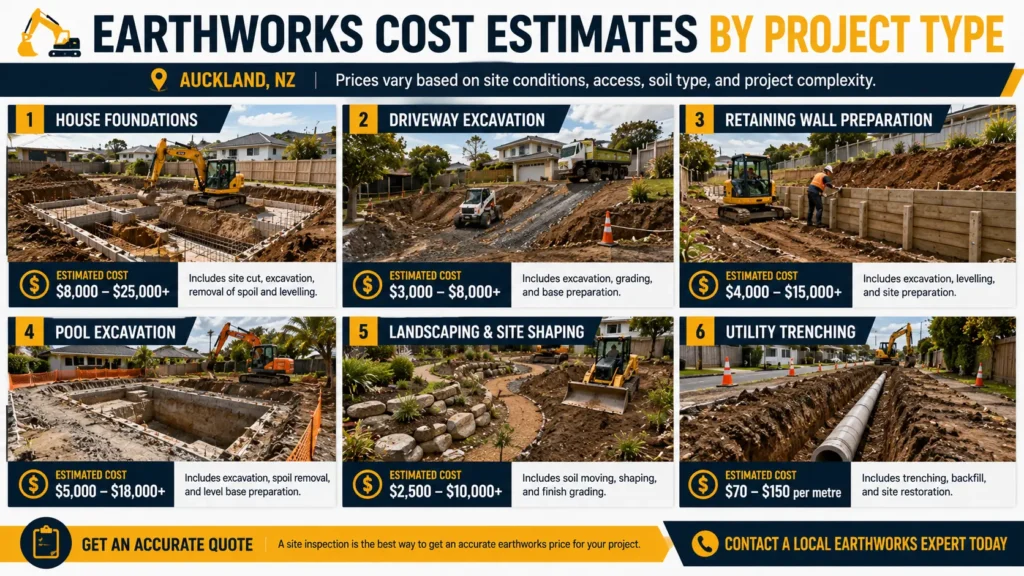
How Contractors Calculate Earthworks Prices
Understanding how contractors prepare an earthworks quote helps you compare pricing more confidently and avoid unexpected costs later in the project. While many people focus on hourly machinery rates, these rates represent only one part of the overall cost. A professional quote considers the entire scope of work, including labour, equipment, excavation volume, transport, disposal, materials, and the work needed to leave the site ready for the next stage of construction. Every property is different, which is why two projects of a similar size can have very different prices.
Labour and Machinery Time
Labour and machinery are usually the largest components of an earthworks quote. Contractors estimate how long each stage of the project will take, what equipment is required, and how many people are needed to complete the work safely and efficiently.
- Operator Experience: An experienced excavator operator can often complete excavation more accurately and efficiently than someone with less experience. Skilled operators reduce unnecessary machine movements, improve productivity, and lower the risk of costly mistakes or rework.
- Number of Workers: Some projects require more than just a machine operator. Ground workers may be needed to guide machinery, check levels, install drainage, manage traffic, or assist with site preparation. Larger or more complex projects generally require a bigger crew.
- Equipment Size: Contractors choose machinery that matches the site’s conditions and the volume of excavation. A compact excavator may be ideal for properties with narrow access, while larger excavators can move significantly more material on open sites. Selecting the right-sized equipment helps improve efficiency without creating unnecessary costs.
- Mobilisation Time: Machinery does not simply arrive ready to work. Contractors must transport equipment to the site, unload it safely, perform pre-start inspections, and position it for operation. These activities require time, labour, and specialised transport, all of which contribute to the overall project cost.
- Setup and Cleanup: Preparing the work area and restoring it afterward are important parts of the job. This may include installing safety barriers, protecting surrounding structures, cleaning the site, loading remaining materials, and preparing the property for the next stage of construction.
Excavation Volume
Excavation volume has a direct impact on pricing because it influences excavation time, machinery requirements, transport needs, and disposal costs. Contractors carefully estimate how much material must be removed before preparing a quote.
- Measuring Cubic Metres: Earthworks are commonly measured in cubic metres rather than square metres because excavation involves depth as well as surface area. Contractors calculate the length, width, and depth of the excavation to estimate the total amount of material that must be moved.
- Bulking of Excavated Soil: Soil expands after it is excavated. This natural increase in volume is known as bulking. For example, material that occupies one cubic metre in the ground may require significantly more space once it has been loosened and loaded into trucks. Contractors account for this when estimating transport and disposal requirements.
- Difference Between In-Ground and Loose Material Volume: Material measured before excavation differs from the volume measured after excavation because air enters the soil during digging. Understanding this difference helps contractors estimate truck movements more accurately and avoid underestimating disposal requirements.
- Impact on Truck Numbers: Larger excavation volumes usually require additional truckloads. Every extra truck movement adds labour, fuel, travel time, tipping fees, and scheduling considerations, all of which influence the final project cost.
Transport and Disposal
Removing excavated material often represents a significant portion of an earthworks budget. The cost depends not only on the amount of material removed but also on where it must be taken and how efficiently it can be transported.
- Distance to Disposal Sites: The further trucks must travel, the higher the transport cost. Fuel consumption, driver time, vehicle wear, and reduced daily productivity all increase with longer travel distances.
- Truck Capacity: Contractors select truck sizes that suit the project. Larger trucks can carry more material in a single trip, while smaller trucks may be necessary for sites with restricted access. Matching truck capacity to site conditions helps improve efficiency.
- Waiting Time: Delays at disposal facilities or while waiting for trucks to be loaded can affect productivity. Extended waiting periods increase labour costs and reduce the amount of productive excavation completed during the day.
- Tipping Fees: Disposal facilities charge fees based on the type and quantity of material delivered. Clean soil is generally less expensive to dispose of than mixed construction waste or contaminated material, which may require specialist handling.
- Return Travel: After unloading, trucks must travel back to the project site for additional loads. Contractors include these return journeys when calculating transport costs because they affect fuel usage, driver hours, and project scheduling.
Materials and Reinstatement
Earthworks projects often involve more than removing soil. Many jobs require imported materials and reinstatement work to prepare the site for construction, landscaping, or paving. These items are usually included as separate cost components within a detailed quote.
- Basecourse: Basecourse provides a stable foundation beneath driveways, paths, building slabs, and paved areas. The required depth and material specification depend on the intended use and the site’s ground conditions.
- Drainage Metal: Free-draining aggregate is commonly installed around drainage pipes, retaining walls, and foundations to improve water movement and reduce the risk of future drainage problems. The quantity required depends on the design and site conditions.
- Topsoil: After heavy excavation, contractors may import topsoil to restore lawns, gardens, or landscaped areas. Good-quality topsoil supports healthy plant growth and provides a finished appearance once construction is complete.
- Clean Fill: Where excavation creates low areas or changes site levels, clean fill may be imported to achieve the required ground profile. Contractors carefully select suitable fill material to meet engineering or landscaping requirements.
- Compaction: Imported materials must usually be compacted in layers to achieve a stable foundation. Proper compaction reduces future settlement and provides suitable support for buildings, driveways, retaining walls, and other structures.
- Surface Restoration: Once excavation is complete, contractors may reinstate disturbed areas by grading the surface, spreading topsoil, reseeding lawns, replacing gravel, or preparing the site for the next trade. Including reinstatement within the quote provides a clearer understanding of the project’s total cost rather than focusing only on excavation.
A detailed earthworks quote considers every stage of the project, from the first machine arriving on-site to the final site restoration. Looking beyond hourly machinery rates allows you to compare quotes more accurately, understand what is included, and choose a contractor who provides clear pricing and realistic expectations for the work ahead.
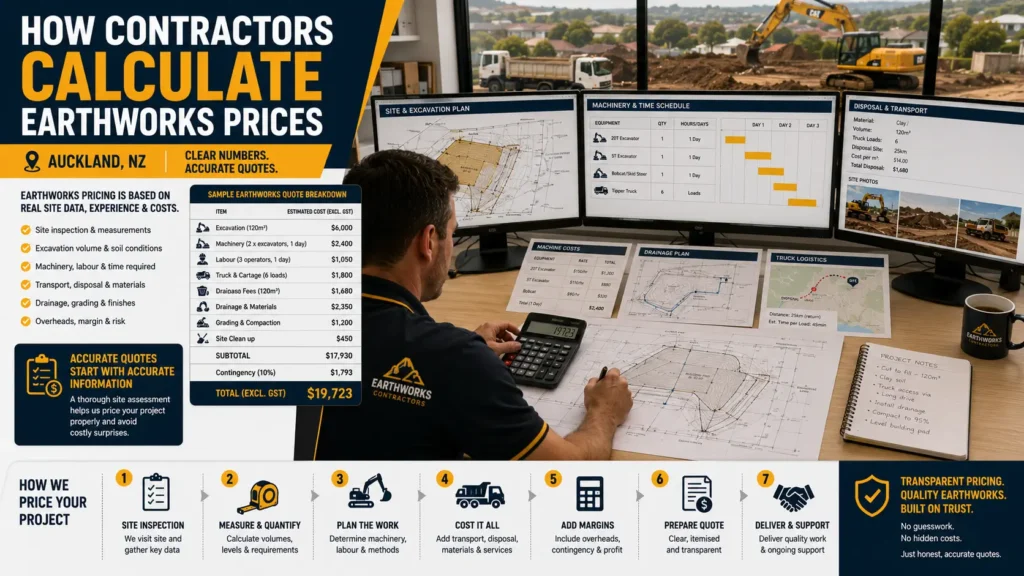
Hidden Earthworks Costs To Plan For
Even the most carefully planned excavation project can uncover conditions that were impossible to identify during an initial site inspection. While experienced contractors work to provide accurate estimates, some costs only become clear once excavation begins. Setting aside a contingency budget helps you manage unexpected discoveries without delaying the project or compromising the quality of the work. Understanding these potential expenses also makes it easier to compare quotes and ask informed questions before construction starts.
Unexpected Rock or Buried Materials
One of the most common reasons an earthworks project exceeds its original budget is the discovery of hidden materials beneath the surface. These obstacles often require additional labour, specialist equipment, or extra disposal, all of which increase the overall project cost.
- Concrete: Old concrete slabs, driveways, footings, or reinforced structures may need to be broken apart using hydraulic breakers before excavation can continue. This process takes more time than excavating soil and may require larger machinery.
- Old Foundations: Properties with previous buildings, sheds, retaining walls, or demolished structures may still contain buried foundations. Removing these materials often involves additional excavation, heavy lifting equipment, and disposal fees.
- Tree Roots: Large root systems can slow excavation and may require careful removal to avoid damaging nearby structures, underground services, or healthy trees that are being retained on the property.
- Rubble: Buried bricks, construction debris, asphalt, and demolition waste are commonly found on older sites. Mixed materials cannot always be disposed of with clean fill, which may result in higher disposal costs.
- Underground Tanks: Some properties contain abandoned fuel tanks, septic tanks, or water storage tanks. These discoveries usually require specialist removal procedures and may involve environmental assessments before work can continue.
Contaminated Soil
Not all excavated soil can be treated as clean fill. Certain sites may contain contaminants from previous industrial activities, fuel storage, chemical use, or illegal dumping. When contamination is suspected or confirmed, strict environmental requirements apply to protect workers, nearby properties, and the surrounding environment.
- Testing Requirements: Soil testing may be required before excavation or after suspicious material is discovered. Laboratory testing helps identify contamination levels and determines how the material must be managed.
- Specialist Handling: Contaminated soil often requires trained personnel using approved handling methods to minimise health and environmental risks during excavation and transport.
- Approved Disposal Facilities: Contaminated material cannot usually be taken to standard clean-fill sites. Instead, it must be transported to licensed disposal facilities that are authorised to accept specific types of contaminated waste.
- Documentation: Environmental regulations often require records showing where contaminated material originated, how it was transported, and where it was disposed of. Proper documentation helps demonstrate compliance with legal requirements and may be requested by regulatory authorities.
Underground Services
Excavating without accurately identifying underground utilities can lead to expensive repairs, project delays, and serious safety risks. Before any digging begins, contractors should locate existing services and confirm their positions using available plans and utility location services where appropriate.
- Power: Underground electrical cables present significant safety hazards if damaged. Repairs can be costly and may result in power outages affecting nearby properties.
- Water: Striking a water main or supply pipe can cause flooding, interrupt water services, and increase repair costs while delaying the project.
- Gas: Damaging underground gas lines creates an immediate safety risk and requires emergency response procedures before excavation can resume.
- Stormwater: Existing stormwater pipes may need to be protected, relocated, or incorporated into the final site design to maintain proper drainage.
- Wastewater: Sewer pipes require careful identification before excavation begins. Damage may create environmental issues and require specialist repairs.
- Fibre and Telecommunications: Modern properties often contain fibre-optic cables and communication lines. Damaging these services can disrupt internet and phone connections while increasing restoration costs.
Weather Delays
Weather has a direct impact on excavation work, particularly in regions that experience frequent rainfall. Wet conditions can affect safety, machinery performance, soil stability, and construction quality. While experienced contractors monitor weather forecasts and plan accordingly, delays are sometimes unavoidable.
- Heavy Rain: Continuous rainfall may stop excavation work until conditions improve. Working in unsafe conditions can increase the risk of machinery becoming stuck or damaging the site.
- Saturated Ground: Waterlogged soil is more difficult to excavate and compact correctly. Additional drying time or soil replacement may be necessary before construction can continue.
- Site Access Damage: Wet conditions can damage temporary access roads, driveways, and construction entrances. Repairing these areas may become an additional project expense.
- Pumping: Water collecting in excavated areas often needs to be pumped out before foundation work, drainage installation, or further excavation can proceed safely.
- Recompaction: Soil disturbed by excessive moisture may require additional compaction to achieve the required stability before the next stage of construction begins.
Extra Engineering or Council Requirements
Some earthworks projects require professional engineering input or regulatory approval before construction can proceed. These requirements help ensure the work is safe, structurally sound, and compliant with local regulations. They can also add to the project budget, particularly on complex sites.
- Geotechnical Reports: A geotechnical investigation assesses soil conditions, ground stability, and foundation suitability. These reports are commonly required for challenging sites, steep slopes, or larger developments.
- Structural Engineering: Excavation supporting retaining walls, foundations, or nearby structures may require structural engineering design and certification to ensure long-term stability.
- Resource Consent: Depending on the scale of the excavation and local planning rules, resource consent may be required before work can begin. Approval timeframes should be considered when planning the project schedule.
- Building Consent: Certain excavation projects associated with structural construction or retaining walls may require building consent before construction starts. Requirements vary according to the scope of work and applicable regulations.
- Erosion and Sediment Controls: Larger earthworks projects often require measures to prevent soil from leaving the site during rainfall. Temporary fencing, sediment traps, stabilised entrances, and drainage controls help protect neighbouring properties and waterways while meeting environmental requirements.
Planning for hidden earthworks costs gives you greater confidence when budgeting and helps reduce the risk of unexpected financial surprises once excavation begins. A detailed site assessment, clear communication with your contractor, and a realistic contingency allowance can make the project smoother, protect your investment, and help keep construction on schedule even when unforeseen conditions arise.
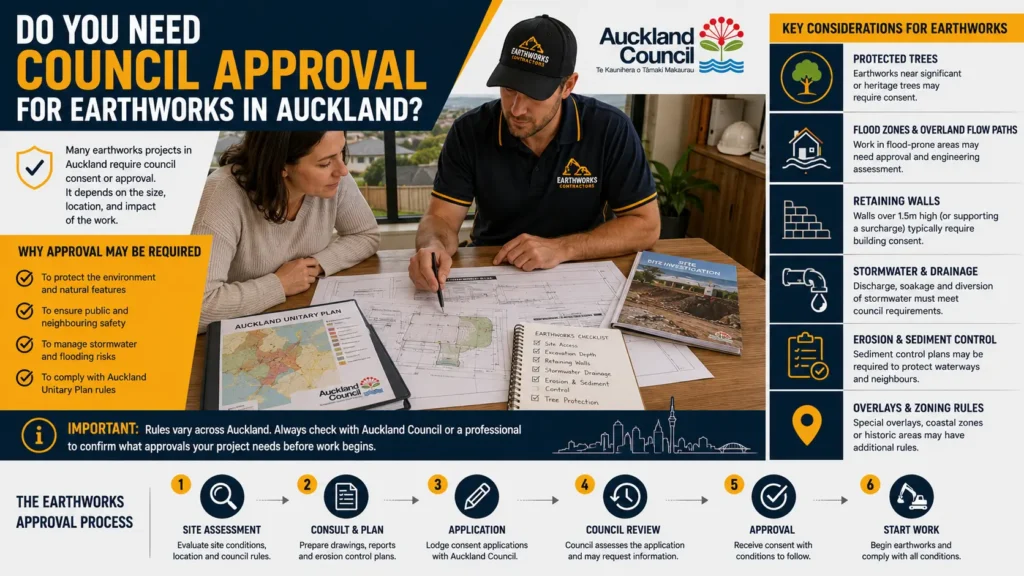
Do You Need Council Approval For Earthworks In Auckland?
Before starting any earthworks project in Auckland, it is important to understand whether council approval is required. The answer depends on several factors, including where the property is located, the size of the excavation, and how the work may affect the surrounding environment or neighboring properties. While many small residential projects can proceed without formal approval, larger or more complex earthworks may require resource consent, building consent, or input from qualified professionals. Checking the requirements early can help prevent costly delays, redesigns, or compliance issues later in the project.
Excavation Volume
The amount of soil being excavated is one of the first factors considered when determining whether approval may be required. Small excavation projects are generally less likely to trigger additional requirements, while large-scale excavation can affect land stability, drainage, and neighboring properties.
Larger excavation projects may require further assessment if they have the potential to:
- Alter Natural Landforms: Significant excavation can permanently change the shape and stability of the land.
- Increase Erosion Risk: Removing large amounts of soil may expose the site to erosion during heavy rainfall.
- Impact Nearby Properties: Deep excavations close to boundaries can influence neighboring land and structures.
- Change Surface Water Flow: Excavation may redirect rainwater if the site is not properly managed.
Every site is different, which is why contractors often assess excavation volume alongside local planning controls rather than relying on excavation size alone.
Fill Volume
Many earthworks projects involve importing clean fill to raise ground levels or create stable building platforms. While adding fill can improve a site’s usability, excessive filling may alter natural drainage patterns and affect surrounding properties.
Council requirements may become more complex when fill:
- Raises Existing Ground Levels: Significant changes in height can affect neighboring land.
- Blocks Natural Drainage: Poorly planned filling may cause water to collect or flow onto adjacent properties.
- Requires Large Quantities of Imported Material: Additional environmental and engineering considerations may apply.
- Changes Existing Land Contours: Altering natural slopes can influence stability and runoff.
Proper planning helps ensure that imported fill supports the project without creating future drainage or settlement problems.
Protected Trees
Some properties contain protected or notable trees that are covered by planning controls. Earthworks carried out near these trees may damage root systems, reduce stability, or affect long-term health.
Work around protected trees may require additional assessment to avoid:
- Root Damage: Excavation can sever structural roots that support the tree.
- Soil Compaction: Heavy machinery may compact soil around the root zone.
- Reduced Water Availability: Changes in surrounding soil levels may affect moisture retention.
- Permanent Tree Decline: Damage may not become visible until months or years after construction.
If mature trees are located near the work area, it is sensible to confirm whether any protections apply before excavation begins.
Flood Zones
Some Auckland properties are located within identified flood-prone areas where earthworks may influence how water moves across the site.
Projects within these areas may require additional consideration because earthworks can:
- Reduce Flood Storage Capacity: Raised ground levels may displace floodwater.
- Increase Flood Risk Elsewhere: Water may be redirected toward neighboring properties.
- Affect Stormwater Systems: Existing drainage infrastructure may require modification.
- Change Site Levels: Even relatively small level changes can affect flood behavior.
Planning for flood management early helps reduce future property risks and supports long-term site performance.
Coastal Areas
Properties located near Auckland’s coastline are often subject to additional planning controls due to their environmental sensitivity.
Earthworks in coastal areas may require closer assessment because they can affect:
- Coastal Stability: Excavation may contribute to erosion on vulnerable land.
- Natural Habitats: Construction activities can disturb protected vegetation and wildlife.
- Water Quality: Sediment runoff may enter nearby waterways or coastal environments.
- Visual Character: Some coastal areas have planning rules that protect landscape values.
Understanding these requirements before work begins can help avoid unnecessary project delays.
Overland Flow Paths
An overland flow path is a natural route where rainwater travels during heavy storms. Many Auckland properties contain mapped flow paths, even if they remain dry most of the year.
Earthworks should avoid disrupting these drainage routes because doing so may:
- Redirect Stormwater: Water may flow toward buildings or neighboring land.
- Increase Flooding: Blocked flow paths can create localized flooding.
- Damage Infrastructure: Roads, driveways, and retaining walls may experience additional water pressure.
- Create Future Drainage Problems: Incorrect site grading may require expensive remedial work later.
Professional site planning can help maintain effective stormwater movement while still achieving the project’s construction goals.
Contaminated Land
Some sites have a history of industrial, commercial, or agricultural activities that may have left contaminants in the soil. Disturbing contaminated land often requires careful handling and disposal procedures.
Potential concerns include:
- Worker Safety: Contaminated soil may require specialist protective measures.
- Environmental Protection: Soil must be managed to prevent contamination of nearby land or waterways.
- Approved Disposal: Certain materials may only be accepted at licensed disposal facilities.
- Additional Testing: Soil investigations may be recommended before excavation starts.
Identifying potential contamination early allows the project to proceed safely and in accordance with applicable environmental requirements.
Steep or Unstable Slopes
Excavation on sloping land requires careful planning because removing or placing soil can affect ground stability.
Sites with steep or unstable slopes may present challenges such as:
- Slope Movement: Excavation can reduce natural support within the hillside.
- Soil Erosion: Exposed slopes may deteriorate during heavy rainfall.
- Foundation Stability: Nearby buildings may be affected if excavation changes ground support.
- Retaining Requirements: Additional structural support may be necessary to maintain long-term stability.
Early engineering advice can help identify suitable excavation methods and reduce construction risks.
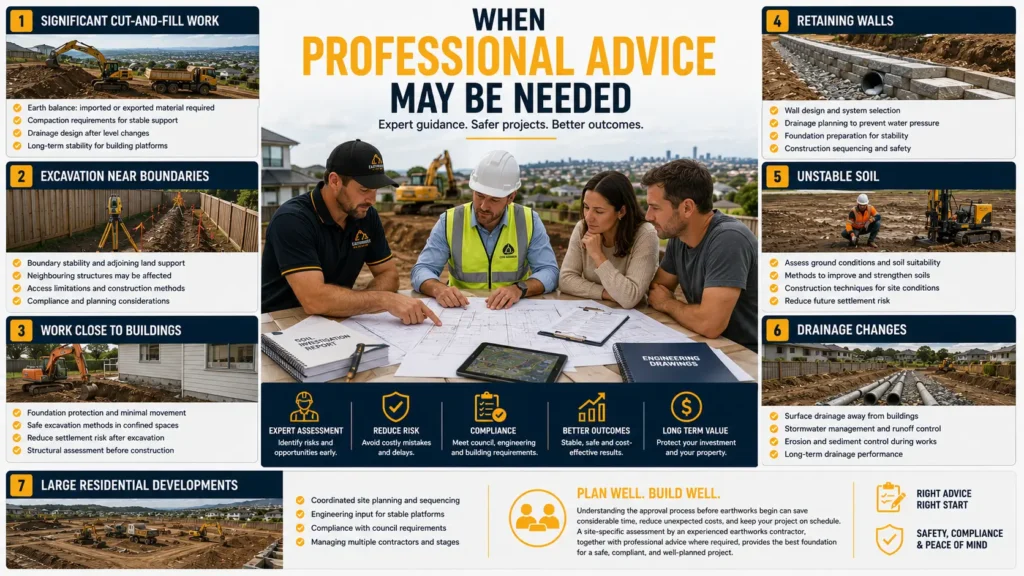
When Professional Advice May Be Needed
Some earthworks projects involve conditions that extend beyond standard residential excavation. In these situations, obtaining advice from experienced professionals can reduce risk, improve compliance, and help ensure the work is completed safely. Seeking guidance early is often more cost-effective than correcting problems after construction has started.
Significant Cut-and-Fill Work
Large cut-and-fill projects change the existing ground profile by removing soil from one area and placing it elsewhere on the site. These projects may influence drainage patterns, slope stability, and future building performance.
Professional advice can help determine:
- Earth Balance: Whether imported or exported material will be required.
- Compaction Requirements: How fill should be placed to provide stable support.
- Drainage Design: How water should be managed after ground levels change.
- Long-Term Stability: Whether the finished platform will remain suitable for construction.
Excavation Near Boundaries
Excavating close to property boundaries requires additional care because neighboring land and structures may be affected.
Professional assessment may help reduce risks involving:
- Boundary Stability: Excavation may weaken support for adjoining land.
- Neighboring Structures: Fences, driveways, or buildings could be affected.
- Access Limitations: Restricted work areas may require different construction methods.
- Compliance Issues: Boundary-related work may need additional planning considerations.
Work Close to Buildings
Excavation near existing homes or other structures should be carefully planned to protect foundations and surrounding infrastructure.
Professional guidance may assist with:
- Foundation Protection: Preventing movement beneath existing buildings.
- Safe Excavation Methods: Selecting equipment suited to confined spaces.
- Settlement Risk: Reducing the likelihood of ground movement after excavation.
- Structural Assessment: Identifying potential risks before construction begins.
Retaining Walls
Retaining walls often form part of larger earthworks projects where ground levels are changing. The wall design should complement the site’s drainage and stability requirements.
Professional input may be valuable for:
- Wall Design: Selecting an appropriate retaining system.
- Drainage Planning: Preventing water pressure behind the wall.
- Foundation Preparation: Providing suitable support for the structure.
- Construction Sequencing: Coordinating excavation and wall installation safely.
Unstable Soil
Not all sites contain firm, predictable ground. Soft soils, loose fill, expansive clay, or saturated ground may require additional investigation before construction proceeds.
Professional assessment can help identify:
- Ground Conditions: Whether the soil is suitable for the proposed work.
- Improvement Methods: Options for strengthening unstable areas.
- Construction Limitations: Machinery or excavation techniques better suited to the site.
- Future Performance: Reducing the likelihood of settlement after completion.
Drainage Changes
Earthworks often alter how water moves across a property. Even minor changes to finished ground levels can influence stormwater flow.
Professional advice may assist with:
- Surface Drainage: Directing water away from buildings.
- Stormwater Management: Protecting neighboring properties from runoff.
- Erosion Control: Reducing sediment movement during construction.
- Long-Term Performance: Maintaining effective drainage after the project is complete.
Large Residential Developments
Large residential projects often involve multiple stages of excavation, drainage, retaining structures, utilities, and building platforms. Careful planning helps coordinate these elements efficiently.
Professional project support may include:
- Site Planning: Coordinating excavation with future construction.
- Engineering Input: Confirming stable building platforms.
- Compliance Guidance: Meeting applicable planning and construction requirements.
- Construction Coordination: Managing sequencing between contractors and consultants.
Understanding the approval process before earthworks begin can save considerable time, reduce unexpected costs, and help keep your project on schedule. A site-specific assessment by an experienced earthworks contractor, together with professional advice where required, provides the best foundation for a safe, compliant, and well-planned project.
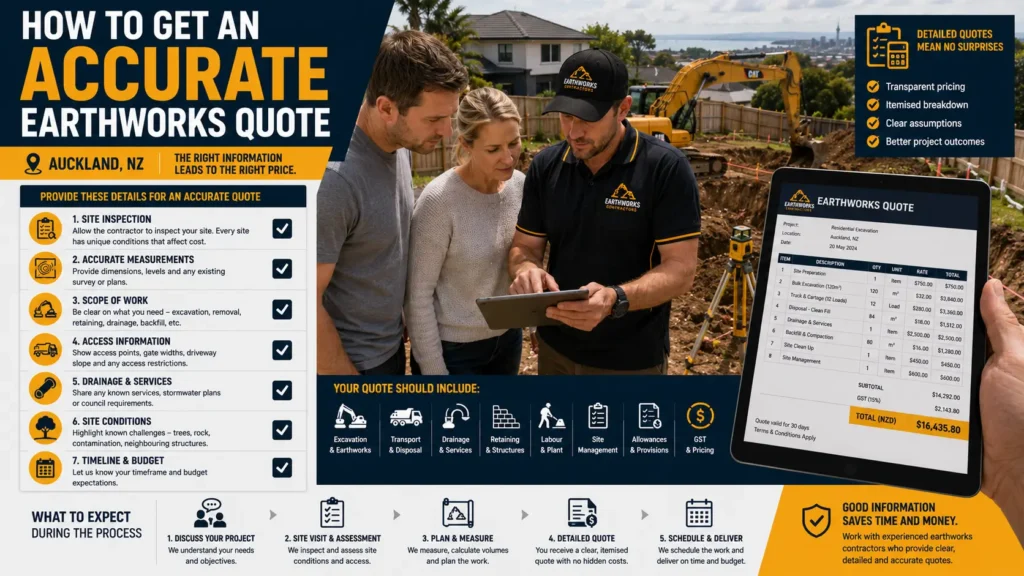
How To Get An Accurate Earthworks Quote
Getting an accurate earthworks quote involves much more than comparing prices from different contractors. Every site has its own challenges, and even two properties on the same street can require different machinery, labour, and excavation methods. A detailed site assessment allows contractors to identify potential issues early, provide a realistic estimate, and reduce the risk of unexpected costs once work begins. Taking the time to prepare the right information and ask the right questions can help you compare quotes fairly and choose the contractor that best suits your project.
Provide a Clear Scope of Work
A detailed scope of work gives contractors the information they need to prepare an accurate quote. Without clear project details, contractors may need to make assumptions, which can lead to price variations or unexpected changes during construction.
Include as much information as possible before requesting a quote.
- Site plans: Provide property plans, survey drawings, or site layouts that show boundaries, existing structures, and access points.
- Required levels: Specify the finished ground levels or excavation depths needed for the project to prevent misunderstandings.
- Excavation dimensions: Include the approximate length, width, and depth of the excavation so contractors can estimate the volume of material to be removed.
- Material specifications: Explain whether the project requires imported fill, basecourse, drainage metal, topsoil, or other construction materials.
- Drainage plans: Identify any planned stormwater, wastewater, or subsoil drainage systems that need to be installed alongside the excavation.
- Completion requirements: Clearly state what should be completed before handover, such as final grading, compaction, spoil removal, or site cleanup.
A well-defined scope helps contractors price the same work, making it much easier to compare quotes accurately instead of comparing different assumptions.
Arrange a Site Visit
An on-site inspection is one of the most important steps in obtaining an accurate earthworks quote. Photographs and measurements provide useful information, but they rarely reveal everything that may affect excavation costs. Walking through the site allows the contractor to identify risks, determine the most suitable equipment, and develop a practical work plan.
During the visit, the contractor will typically assess several important factors.
- Access inspection: Evaluate driveway width, gate openings, turning areas, slopes, overhead power lines, trees, and any obstacles that may restrict machinery.
- Soil assessment: Check whether the ground contains clay, rock, unstable soil, fill material, or signs of excessive moisture that may affect excavation.
- Machinery selection: Determine the most suitable excavators, loaders, trucks, compactors, or specialised equipment based on site conditions and project size.
- Disposal planning: Estimate how much excavated material will need to be removed, where it can be taken, and how many truck loads may be required.
- Utility risks: Identify visible signs of underground services such as water pipes, gas lines, power cables, sewer connections, and telecommunications infrastructure that may require locating before excavation begins.
A site visit also gives homeowners the opportunity to ask questions, discuss possible challenges, and understand how the contractor plans to complete the work safely and efficiently.
Ask for an Itemised Quote
An itemised quote provides much greater transparency than a single total price. Breaking down the costs allows you to understand exactly what is included and helps identify differences between competing quotes.
A detailed quotation should clearly explain each major cost component.
- Machinery: List the equipment being used, including excavators, loaders, compactors, trucks, and any specialised attachments.
- Labour: Show the estimated labour costs based on the number of workers and expected project duration.
- Trucking: Include transport costs for moving machinery to the site and hauling excavated material away.
- Disposal: Outline tipping fees and disposal costs for clean fill, mixed waste, or contaminated material where applicable.
- Materials: Identify any imported fill, aggregate, drainage products, topsoil, or other construction materials included in the project.
- Permits: State whether consent-related costs, traffic management, or other approvals are included or excluded.
- Provisional sums: Highlight any estimated allowances for work that cannot be accurately priced until excavation begins, such as unexpected rock removal.
- Taxes: Confirm whether applicable taxes are included in the quoted price so there are no surprises later.
When comparing quotes, focus on what each contractor is providing rather than choosing the lowest price alone. A cheaper quote may exclude important items that will later become additional charges.
Confirm What Happens if Conditions Change
Even with careful planning, unexpected conditions can arise once excavation begins. The ground beneath the surface is not always predictable, and some issues only become visible after machinery starts digging.
Discussing these possibilities before work starts helps establish clear expectations and reduces the likelihood of disputes if additional work becomes necessary.
- Rock excavation: Ask how additional charges will be handled if solid rock or hard ground requires specialised equipment or extra labour.
- Contaminated soil: Confirm the process for testing, handling, transporting, and disposing of contaminated material if it is discovered.
- Extra disposal: Discuss how costs will be managed if more excavated material needs to be removed than originally estimated.
- Weather delays: Understand how heavy rain, saturated ground, or unsafe site conditions may affect project timelines and pricing.
- Additional machinery: Clarify how the quote may change if larger excavators, rock breakers, pumps, or extra trucks become necessary.
- Scope changes: Ask how variations requested by the property owner after work has started will be priced and approved before proceeding.
A professional contractor should explain how unexpected conditions are managed, document any required changes, and obtain approval before carrying out additional work. This level of transparency helps protect both parties and keeps the project moving smoothly.
Taking the time to prepare detailed project information, arrange a thorough site inspection, and request a transparent itemised quote gives you a much stronger foundation for making an informed decision. It also helps reduce unexpected costs, improves communication with your contractor, and increases the likelihood of a successful earthworks project from start to finish.
How To Compare Earthworks Contractors
Choosing an earthworks contractor is about much more than finding the lowest quote. A lower price can sometimes mean important services have been left out, increasing the likelihood of unexpected costs once work begins. Taking the time to compare contractors based on experience, safety, transparency, and the quality of their proposals will help you choose a team that can complete the project efficiently while reducing the risk of delays, disputes, or expensive mistakes.
Check Relevant Experience
Not all earthworks projects involve the same challenges. A contractor who regularly prepares residential building sites may not have the same expertise as one who specializes in large-scale commercial developments, and vice versa. Look for experience that closely matches the type of work you need rather than relying solely on how long the business has been operating.
- Similar residential or commercial projects: Ask whether the contractor has completed projects similar in size and complexity to yours. A company with relevant experience is more likely to anticipate challenges and provide realistic timelines and pricing.
- Auckland ground conditions: Auckland has a wide range of soil types, including clay, volcanic rock, sandy areas, and reclaimed land. Contractors familiar with local conditions can recommend suitable excavation methods, drainage solutions, and machinery for your site.
- Restricted-access sites: Properties with narrow driveways, limited working space, steep terrain, or nearby buildings require careful planning. Experienced contractors understand how to work safely in confined areas while minimizing disruption and property damage.
- Drainage and slope work: Earthworks often involve more than moving soil. Contractors with drainage and slope stabilization experience can help prevent erosion, water pooling, and long-term ground movement that may affect future construction.
- Excavation near existing structures: Digging close to homes, retaining walls, driveways, or underground infrastructure requires precision. Contractors who regularly work around existing structures understand how to protect foundations, utilities, and surrounding property during excavation.
Review Insurance and Safety Practices
Safety should never be treated as an optional extra. Earthworks involve heavy machinery, underground utilities, changing weather conditions, and uneven ground, all of which require careful planning and professional risk management. A contractor with strong safety procedures helps protect workers, property owners, and neighboring properties.
- Public liability insurance: Confirm that the contractor carries appropriate insurance to cover accidental property damage or third-party claims. Insurance provides peace of mind if something unexpected occurs during the project.
- Trained operators: Excavators, loaders, compactors, and other heavy equipment should only be operated by qualified personnel. Skilled operators are more efficient, reduce the risk of accidents, and produce higher-quality work.
- Site safety plans: Professional contractors prepare safety plans before work begins. These plans identify potential hazards, outline emergency procedures, and establish safe working practices for everyone on site.
- Utility checks: Before excavation starts, underground services such as water, gas, electricity, wastewater, and telecommunications should be identified. Locating these services helps prevent costly damage and dangerous incidents.
- Traffic management: Projects near busy roads or public spaces may require temporary traffic management measures. Contractors should understand when traffic control is necessary and how to comply with local requirements to keep both workers and the public safe.
Compare Quote Inclusions
A detailed quote provides much more than a final price. It explains exactly what work will be completed and helps you compare contractors fairly. Two quotes with similar totals may include very different services, making it essential to review every item before making a decision.
- Mobilisation: Check whether transporting machinery, equipment, and operators to your site is included or charged separately.
- Disposal: Confirm if the quote covers removing excavated soil, construction waste, and disposal fees, or if these costs will be billed later.
- Materials: Review whether imported fill, aggregate, drainage stone, topsoil, or other required materials are included in the quoted price.
- Cleanup: A professional contractor should clearly explain what level of site cleanup will be completed after the earthworks are finished.
- Compaction: Proper compaction is essential for foundations, driveways, and landscaped areas. Verify whether testing or compaction work forms part of the quoted scope.
- Reinstatement: Some projects require restoring disturbed surfaces, replacing topsoil, or repairing affected areas after excavation. Make sure these tasks are clearly identified if needed.
- Additional rates: Ask for hourly rates or pricing that applies if unexpected rock, contaminated soil, extra excavation, or weather delays increase the project scope. Understanding these rates helps avoid surprises later.
Look for Verifiable Trust Signals
A reliable contractor should be able to demonstrate their experience and professionalism through evidence rather than marketing claims. Looking beyond advertising helps you make a more informed decision and reduces the likelihood of hiring an inexperienced provider.
- Recent project photos: Ask to see photographs from recently completed earthworks projects. Images can demonstrate workmanship, equipment quality, and the types of projects the contractor regularly completes.
- Detailed reviews: Read customer reviews that describe the overall experience rather than focusing only on star ratings. Feedback about communication, reliability, cleanliness, and problem-solving can provide valuable insight.
- Local references: Speaking with previous clients or viewing completed projects in your area can help confirm the contractor’s reputation and the quality of their work.
- Clear business details: Established contractors should provide accurate contact information, a physical business address where applicable, company registration details, and a professional website that clearly explains their services.
- Written contracts: Every project should be supported by a written agreement outlining the scope of work, payment schedule, timeline, responsibilities, and procedures for handling changes or unexpected conditions.
- Transparent payment terms: Reliable contractors explain payment schedules before work begins and avoid vague pricing or unexpected requests for additional payments without proper documentation.
Taking the time to compare earthworks contractors carefully can help you avoid unnecessary costs, reduce project risks, and achieve a better outcome. A contractor who combines relevant experience, clear communication, transparent pricing, and strong safety practices is far more likely to deliver reliable results than one chosen solely because they submitted the lowest quote.
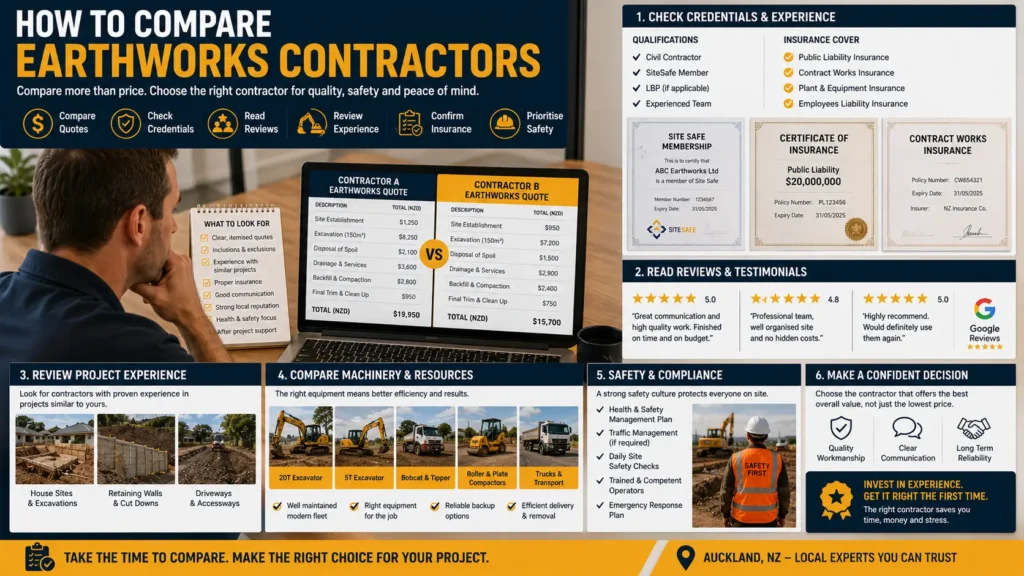
Ways To Reduce Earthworks Costs
Keeping earthworks costs under control is not about choosing the cheapest contractor or cutting corners. It is about planning the project carefully, making informed decisions before machinery arrives, and reducing unnecessary delays or rework. Good preparation helps contractors work more efficiently, minimizes material waste, and lowers the risk of unexpected expenses while maintaining safety and quality throughout the project.
Finalise Plans Before Excavation Starts
One of the most effective ways to reduce earthworks costs is to complete all planning before excavation begins. Changes made after machinery is already on-site often result in additional labor, extra equipment time, and unnecessary material movement. Even small design adjustments can create delays that increase the overall project cost.
Before work starts, make sure the excavation area, finished ground levels, and construction requirements have been confirmed by everyone involved. This allows the contractor to complete the work in the correct sequence without stopping to revise the plan.
- Avoid Design Changes: Make final decisions on building layouts, retaining walls, driveways, drainage systems, and landscaping before excavation begins. Mid-project changes often require additional digging, backfilling, and compaction.
- Confirm Finished Levels: Ensure all finished floor levels, driveway heights, drainage falls, and site contours have been approved. Incorrect levels can require expensive rework after excavation has been completed.
- Coordinate Trades: Builders, plumbers, electricians, drainage contractors, and engineers should understand the project schedule before excavation starts. Good coordination reduces delays and prevents completed work from being disturbed later.
- Mark Underground Utilities: Identify water pipes, sewer lines, stormwater pipes, gas services, electrical cables, and communication lines before excavation. Locating utilities early reduces the risk of accidental damage, service interruptions, and emergency repair costs.
Spending extra time planning before work begins is usually far less expensive than correcting mistakes once excavation is underway.
Reuse Suitable Material On-Site
Excavated material is not always waste. In many residential earthworks projects, suitable soil can be reused elsewhere on the property, reducing disposal fees and lowering the amount of imported fill required. Reusing material can also reduce truck movements, which helps lower transport costs and minimizes disruption around the site.
The suitability of excavated material depends on its quality, moisture content, stability, and the intended use. Contractors will normally assess whether the material can safely remain on-site or whether it should be removed.
- Landscaping Fill: Clean soil may be reused to shape garden beds, create gentle slopes, or improve outdoor areas where structural strength is not required.
- Backfilling: Suitable excavated material can often be placed behind retaining walls or around services when it meets engineering or drainage requirements. Proper compaction remains essential to prevent future settlement.
- Levelling: Clean fill can be reused to level uneven sections of the property before lawns, gardens, or paved areas are installed.
- Unsuitable Material: Soil containing contamination, excessive organic matter, tree roots, construction debris, unstable clay, or poor drainage characteristics should generally not be reused. In these situations, removal and replacement with approved fill may provide a safer and more reliable outcome.
Reusing suitable material can provide meaningful savings without affecting the quality of the completed project.
Improve Site Access
Easy access allows machinery to work efficiently and safely. Restricted access often requires smaller equipment, additional labor, or more time to complete the same amount of work. Improving access before excavation begins can reduce equipment hours and improve productivity.
Property owners can often make simple changes before the contractor arrives that help reduce delays during the project.
- Remove Obstacles: Clear fences, temporary structures, stored materials, garden furniture, trailers, or vegetation that could restrict machinery movement.
- Arrange Parking: Reserve suitable parking areas for trucks, machinery, and support vehicles to reduce unnecessary travel time between the site and nearby streets.
- Clear Machinery Routes: Ensure excavators, loaders, dump trucks, and other equipment have safe paths into and around the work area. Stable ground and adequate turning space improve operating efficiency.
- Coordinate Neighbours: If temporary access across neighboring land or shared driveways is required, discuss arrangements in advance. Early communication can prevent delays once work begins.
Better access allows contractors to complete excavation more efficiently while reducing labor time and machinery operating costs.
Group Related Work Together
Combining several excavation-related tasks into one project can often reduce overall costs. Mobilizing heavy equipment, transporting machinery, and setting up the site all involve fixed expenses. Completing multiple tasks during the same visit allows those costs to be shared across the project.
Grouping related work also reduces disruption to the property and helps different contractors coordinate their activities more effectively.
- Drainage Installation: Complete drainage trenches while excavation equipment is already on-site instead of scheduling a separate visit later.
- Driveway Preparation: Excavate and prepare driveway areas during the same project to reduce additional machinery transport and setup costs.
- Foundation Work: Coordinate foundation excavation with other site preparation activities to improve workflow and reduce repeated excavation.
- Retaining Wall Excavation: Prepare retaining wall footings, drainage trenches, and surrounding excavation during the same earthworks stage whenever possible.
- Landscaping Preparation: Shape gardens, level outdoor spaces, and prepare planting areas before machinery leaves the site, reducing the need to hire equipment again later.
A well-organized project often costs less than completing each task separately over several months.
Choose the Right Machinery
Selecting machinery that matches the project is an important part of controlling earthworks costs. Larger machines may appear faster, but they are not always the most economical option. Smaller equipment may fit confined sites more easily but can increase labor time if the excavation volume is significant.
Experienced earthworks contractors choose machinery based on site conditions, access restrictions, excavation depth, and the amount of material that needs to be moved.
- Avoid Oversized Equipment: Large excavators may increase transport costs, require additional working space, and create unnecessary ground disturbance on smaller residential sites.
- Avoid Equipment That Is Too Small: Undersized machinery may take much longer to complete excavation, increasing labor hours and extending the project timeline.
- Match Machinery to the Job: The most cost-effective approach is selecting equipment that suits both the available access and the excavation volume. Properly matched machinery improves productivity, reduces fuel consumption, and helps complete the work within the planned schedule.
Professional contractors typically assess access, soil conditions, excavation depth, and project scope before deciding which machinery will deliver the best balance of efficiency, safety, and cost.
Careful planning before excavation begins often delivers the greatest savings throughout an earthworks project. By finalizing the design, preparing the site, coordinating related work, and selecting the right equipment for the conditions, property owners can reduce unnecessary expenses while helping the project progress safely and efficiently from start to finish.
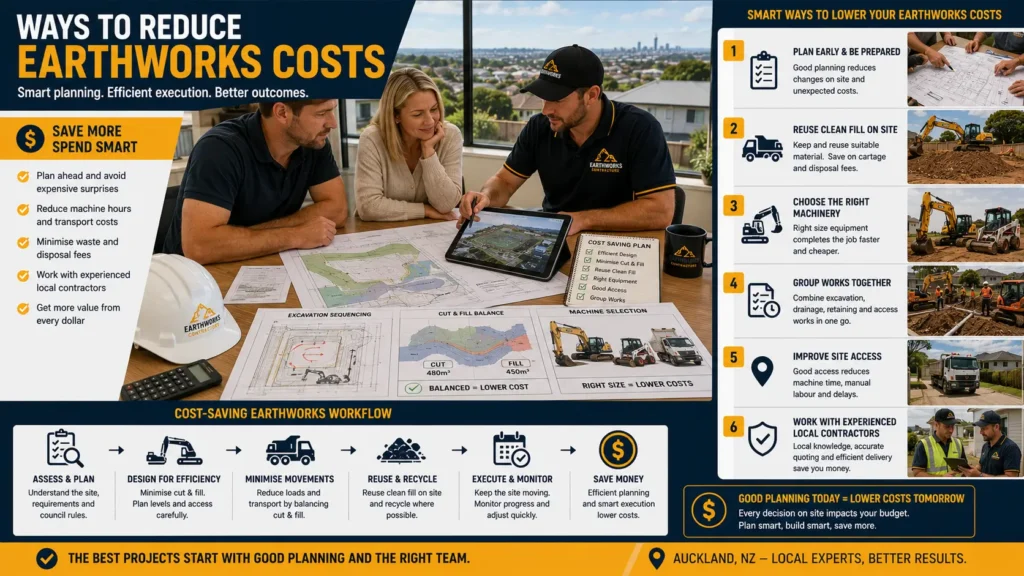
Common Earthworks Pricing Mistakes To Avoid
Earthworks projects often appear straightforward at first, but small planning mistakes can quickly increase costs, delay schedules, and create unnecessary complications. A low quote or a fast start may seem appealing, yet overlooking important details before excavation begins can lead to expensive variations once machinery is on-site. Understanding the most common pricing mistakes helps you compare quotes more accurately, prepare a realistic budget, and reduce the risk of unexpected costs throughout your project.
Accepting A Quote Without A Site Inspection
A quote based only on photographs, measurements, or a phone conversation rarely tells the full story. Every site has unique conditions that can significantly affect excavation time, machinery requirements, and disposal costs.
A professional site inspection allows the contractor to evaluate factors such as:
- Site access: Whether machinery can safely enter and operate on the property.
- Ground conditions: Clay, rock, soft soil, or saturated areas that may require different excavation methods.
- Existing structures: Nearby buildings, retaining walls, fences, or landscaping that need protection.
- Elevation changes: Sloping land that may require additional excavation or retaining solutions.
- Drainage requirements: Existing stormwater systems or areas prone to water accumulation.
Without seeing these conditions firsthand, contractors often need to make assumptions. If those assumptions prove incorrect, the project may require additional labour, machinery, or materials that increase the final cost.
A site inspection also gives homeowners the opportunity to discuss project goals, ask questions, and clarify exactly what is included in the quotation before work begins.
Comparing Totals Without Comparing Inclusions
Many homeowners compare only the final price when reviewing multiple quotes. While this seems logical, the lowest total does not always represent the best value.
Two quotes with similar prices may include very different scopes of work.
Carefully compare items such as:
- Machinery hire: Equipment size, operating hours, and transport charges.
- Labour: Number of workers included and estimated working time.
- Material disposal: Whether excavation spoil removal is included.
- Imported materials: Basecourse, clean fill, aggregate, or topsoil.
- Site restoration: Final grading, compaction, and cleanup.
- Drainage work: Installation of drainage systems if required.
A cheaper quote may exclude several essential services that another contractor has already included. Once those additional items are added later, the overall project may cost more than the higher initial quote.
Reviewing itemized quotations allows you to compare each contractor fairly and understand exactly what you are paying for.
Ignoring Disposal Costs
Removing excavated material is often one of the largest expenses in an earthworks project. Many people focus on excavation costs while overlooking the cost of transporting and disposing of excess soil.
Disposal expenses vary depending on:
- Material type: Clean soil, clay, rock, construction debris, or contaminated material.
- Volume removed: Larger excavation projects require additional truckloads.
- Travel distance: Disposal facilities located farther away increase transport time.
- Landfill or tipping fees: Different facilities charge different disposal rates.
- Loading requirements: Multiple loading cycles may increase machinery time.
If disposal costs are not clearly included in the quote, homeowners may receive unexpected variation charges once excavation is underway.
Always ask where excavated material will be taken and whether disposal fees are fully included in the quoted price.
Failing To Locate Underground Services
Underground utilities can present significant safety risks and costly delays if they are not identified before excavation begins.
Buried services may include:
- Water supply lines: Damaging them can interrupt water service and require immediate repairs.
- Gas pipelines: Accidental strikes create serious safety hazards.
- Electrical cables: Underground power can be dangerous and expensive to repair.
- Stormwater systems: Existing drainage infrastructure may require protection.
- Telecommunications: Fibre and communication cables can be costly to replace.
Locating these services before excavation reduces the risk of damage, project delays, and repair costs. Contractors often recommend confirming utility locations before machinery arrives on-site.
Underestimating Soil Volume
Excavated soil expands once it is removed from the ground. This means the amount of material requiring transport is often greater than many property owners expect.
Several factors influence the final excavation volume, including:
- Excavation depth: Deeper excavations naturally produce more spoil.
- Ground composition: Clay and loose soils expand differently after excavation.
- Project dimensions: Even small increases in width or depth significantly affect total volume.
- Stockpile requirements: Temporary storage areas may also need preparation.
Underestimating soil volume can result in additional truckloads, higher disposal costs, and extended excavation time.
Experienced contractors calculate excavation volumes carefully before preparing a quotation to reduce the likelihood of unexpected adjustments.
Starting Without Final Plans
Beginning excavation before construction plans are finalized often leads to unnecessary rework.
Design changes after excavation has started may require:
- Additional digging: Revising foundation or drainage locations.
- Extra backfilling: Replacing previously excavated material.
- Repeated machinery hire: Bringing equipment back to the site.
- Material replacement: Ordering additional fill or aggregate.
- Schedule changes: Coordinating revised work with other trades.
Completing the design process before excavation begins helps reduce waste, improve scheduling, and keep the project within budget.
It also allows contractors to prepare a more accurate quotation because the project scope is clearly defined from the beginning.
Choosing A Contractor Based Only On Price
Price is important, but it should never be the only deciding factor.
An unusually low quote may indicate that important work has been excluded or underestimated.
Consider factors such as:
- Relevant experience: Similar residential or commercial earthworks projects.
- Equipment suitability: Machinery appropriate for the site’s conditions.
- Communication: Clear explanations and transparent pricing.
- Insurance coverage: Protection for both the contractor and the property owner.
- Project planning: Detailed scheduling and realistic timelines.
- Workmanship: Proven quality demonstrated through completed projects and customer feedback.
Selecting an experienced contractor who provides a detailed, transparent quote often delivers better long-term value than simply accepting the lowest price available.
Leaving Drainage Until After Excavation
Drainage should be considered during the planning stage, not after excavation has been completed.
Poor drainage planning can create ongoing problems such as water pooling, soil movement, erosion, and structural instability.
Early drainage planning allows contractors to:
- Install drainage efficiently: While excavation equipment is already on-site.
- Protect foundations: Reduce water pressure around structures.
- Improve site stability: Manage surface and subsurface water movement.
- Reduce future excavation: Avoid reopening completed areas later.
- Support long-term performance: Minimize erosion and water-related damage.
Planning drainage alongside excavation is generally more cost-effective than modifying the completed project later.
Failing To Budget For Unexpected Ground Conditions
Even after careful planning, some site conditions remain hidden until excavation begins.
Unexpected discoveries may include:
- Rock formations: Requiring rock breakers or specialized equipment.
- Old foundations: Previous construction materials buried below ground.
- Tree roots: Large root systems that slow excavation.
- Contaminated soil: Material requiring specialist handling and disposal.
- Groundwater: Water management measures that were not originally anticipated.
Setting aside a reasonable contingency budget helps reduce financial stress if unexpected conditions arise. While experienced contractors work to identify potential issues during the site inspection, no excavation project can guarantee that every underground condition will be visible beforehand.
Taking the time to compare detailed quotes, confirm project inclusions, and plan for site-specific conditions can save both time and money. A well-prepared earthworks project is far more likely to stay on schedule, remain within budget, and deliver the outcome you expect with fewer unexpected surprises.
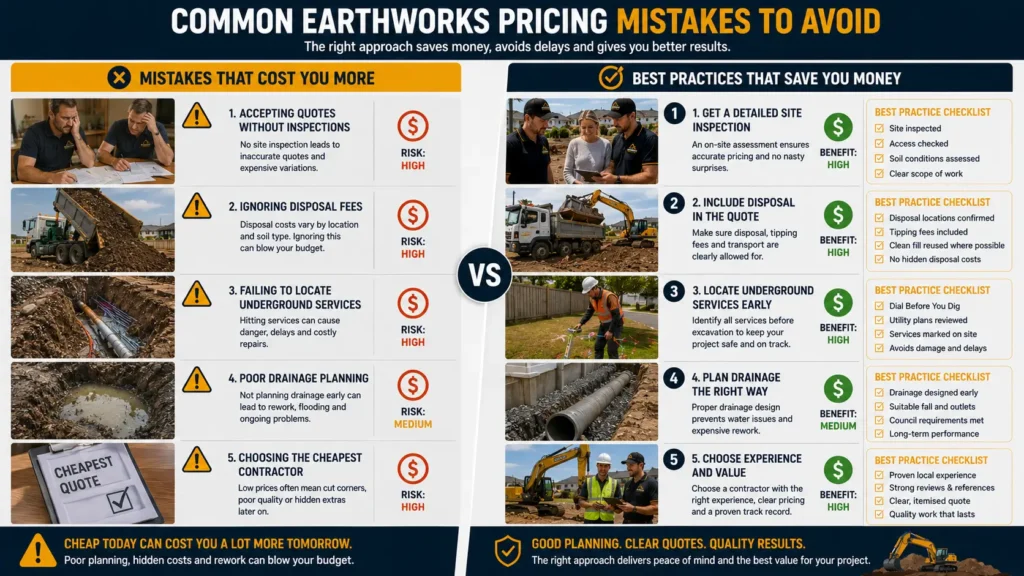
Questions To Ask Before Hiring An Earthworks Contractor
Choosing the right earthworks contractor is about more than comparing prices. A detailed conversation before work begins can help you understand exactly what you are paying for, reduce the risk of unexpected costs, and give you confidence that the project will be completed safely and professionally. Asking the right questions also makes it easier to compare contractors on value rather than price alone.
Pricing Questions
Before accepting a quote, make sure you understand how the contractor has calculated the price and whether there are any additional costs that could arise during the project. A detailed quote provides greater transparency and helps prevent misunderstandings later.
Is the Quote Fixed or Estimated?
A fixed-price quote means the contractor agrees to complete the agreed scope of work for a set amount, provided the project conditions remain as expected. This option offers greater budget certainty for many homeowners.
An estimated quote is different because it is based on the contractor’s best assessment before excavation begins. If unexpected site conditions are discovered, such as buried concrete, rock, or poor soil, the final cost may increase.
Ask the contractor to explain:
- Pricing method: Whether the quote is fixed, estimated, or a combination of both.
- Scope limitations: Which parts of the work are covered by the quoted price.
- Possible variations: What circumstances could lead to additional charges.
- Approval process: Whether extra work requires your approval before it proceeds.
What Is Included in the Price?
Not every quote includes the same services. Two quotes that appear similar can differ significantly once you compare the details.
Request an itemized breakdown showing exactly what has been included.
Look for items such as:
- Excavation: Site cutting, digging, and shaping.
- Machinery: Equipment hire and operator costs.
- Labour: Additional workers required on-site.
- Site preparation: Clearing vegetation or removing existing materials.
- Compaction: Preparing the ground for construction.
- Cleanup: Removing debris and leaving the site tidy.
Knowing exactly what is included makes it much easier to compare competing quotes fairly.
Are Disposal Fees Included?
Removing excavated soil often represents a significant part of an earthworks project, particularly when large volumes of material must leave the site.
Some contractors include disposal in the quoted price, while others list it separately or charge according to the final volume removed.
Ask about:
- Disposal costs: Whether tipping fees are included.
- Transport charges: Trucking costs to disposal facilities.
- Material classification: Whether clean fill and mixed waste are priced differently.
- Volume estimates: How disposal costs are calculated if more material is excavated than expected.
Understanding these costs early helps prevent unexpected additions to the final invoice.
What Are the Hourly Rates for Extra Work?
Even well-planned projects can change after excavation begins. Hidden obstacles or design changes may require extra labour or machinery.
Before work starts, ask about the contractor’s hourly rates for additional services.
Important questions include:
- Machine rates: Hourly charges for each type of equipment.
- Labour rates: Additional worker costs.
- Minimum charges: Whether minimum hire periods apply.
- After-hours work: Any higher rates for work outside normal operating hours.
Clear answers allow you to estimate potential costs if unexpected work becomes necessary.
Are Mobilisation and Transport Included?
Machinery must be transported to and from the project site, and these costs may or may not be included in the quote.
Transport costs can vary depending on equipment size and travel distance across Auckland.
Clarify whether the quote includes:
- Equipment delivery: Transporting machinery to the site.
- Equipment removal: Collection after the project finishes.
- Fuel costs: Any machinery fuel charges.
- Travel time: Operator travel allowances where applicable.
Knowing this information helps you compare quotes on a like-for-like basis.
Project Questions
Pricing is only one part of selecting a contractor. Understanding how the work will actually be completed provides valuable insight into the contractor’s planning, experience, and professionalism.
Which Machinery Will Be Used?
Different projects require different equipment. Using machinery that suits the site can improve productivity while minimizing damage to surrounding areas.
Ask why specific machines have been selected for your project.
Examples include:
- Mini excavators: Suitable for restricted-access residential sites.
- Large excavators: Better for substantial excavation volumes.
- Skid-steer loaders: Useful for moving material in confined spaces.
- Compactors: Essential for preparing stable building platforms.
- Tip trucks: Used to remove excavated material efficiently.
A contractor who can clearly explain machinery choices demonstrates careful project planning.
How Long Should the Work Take?
A realistic timeline helps you coordinate other trades, deliveries, inspections, and overall project scheduling.
Ask what assumptions the timeline is based on and what factors could affect completion.
Potential influences include:
- Weather conditions: Heavy rain may delay excavation.
- Ground conditions: Rock or unstable soil may require additional work.
- Material disposal: Truck availability can influence progress.
- Access limitations: Difficult sites often require smaller machinery and more time.
An experienced contractor should provide a practical timeframe rather than an unrealistic promise.
Where Will Excavated Material Go?
Excavation produces significant volumes of soil, rock, and construction waste. Understanding how this material will be managed is important for both cost and environmental responsibility.
Ask whether suitable material can remain on-site or whether everything will be removed.
Discuss:
- Reuse opportunities: Suitable fill for landscaping or backfilling.
- Off-site disposal: Licensed disposal facilities.
- Clean fill options: Material that may be reused elsewhere.
- Environmental practices: Responsible handling of waste materials.
A clear disposal plan helps avoid unnecessary transport costs and delays.
How Will Drainage Be Managed?
Drainage is often one of the most important aspects of an earthworks project. Poor drainage can contribute to erosion, settlement, retaining wall movement, and long-term structural issues.
Ask how drainage will be addressed during excavation.
Important considerations include:
- Surface water: Managing rainwater during construction.
- Subsoil drainage: Preventing water buildup below ground.
- Stormwater connections: Protecting surrounding properties.
- Finished site levels: Directing water away from structures.
Proper drainage planning protects the investment long after excavation is complete.
What Happens If Rock or Contaminated Soil Is Found?
Unexpected site conditions are common during excavation. Knowing how the contractor manages these situations helps prevent confusion later.
Ask how additional work will be handled if unexpected materials are encountered.
Topics to discuss include:
- Rock excavation: Whether specialist equipment may be required.
- Contaminated soil: Testing and disposal procedures.
- Variation approval: How additional costs are communicated.
- Work delays: Expected impact on the project schedule.
A contractor who explains these possibilities upfront is usually demonstrating transparent project management.
Trust and Compliance Questions
Technical ability is important, but professionalism and compliance are equally essential. Asking these questions helps confirm that the contractor follows industry standards and operates responsibly.
Are You Insured?
Insurance protects both the contractor and the property owner if something unexpected occurs during construction.
Ask what insurance policies are currently in place.
These commonly include:
- Public liability insurance: Protection against property damage or third-party claims.
- Equipment insurance: Cover for machinery damage or theft.
- Worker protection: Appropriate insurance for employees where required.
Request proof of current insurance if appropriate.
Have You Completed Similar Projects?
Experience with projects similar to yours often leads to smoother planning and fewer unexpected problems.
Ask about previous work involving:
- Residential excavation: House sites and landscaping.
- Driveway preparation: Excavation and base preparation.
- Retaining walls: Excavation and drainage.
- Foundation work: Building platform preparation.
- Difficult sites: Sloping sections or restricted access.
Experienced contractors can usually explain previous challenges and how they resolved them.
Who Will Operate the Machinery?
The quality of excavation depends heavily on the skill of the machine operator.
Ask whether the operator has experience with projects similar to yours and whether the same person who prepared the quote will oversee the work.
Useful questions include:
- Operator experience: Years working with earthmoving equipment.
- Project supervision: Who manages the work on-site.
- Communication: Your main point of contact throughout the project.
- Safety procedures: How risks are managed during excavation.
Knowing who will actually perform the work provides greater confidence in the project’s execution.
Will Permits or Traffic Management Be Required?
Certain earthworks projects require approvals or temporary traffic management, particularly near public roads or larger developments.
Ask whether the contractor will identify any requirements before work begins.
This may include:
- Council approvals: Where applicable.
- Traffic management: For roadside excavation.
- Utility coordination: Locating underground services.
- Site safety measures: Protecting workers and the public.
Understanding these responsibilities early helps avoid delays.
Will the Site Be Compacted and Cleaned After Completion?
Finishing the project properly is just as important as the excavation itself.
Confirm what the contractor will do before leaving the site.
Ask whether the project includes:
- Ground compaction: Preparing stable surfaces for future construction.
- Final grading: Achieving the required finished levels.
- Site cleanup: Removing debris and excess material.
- Equipment removal: Leaving the property safe and accessible.
A well-finished site reduces the amount of additional work required before the next stage of construction begins.
Taking time to ask detailed questions before hiring an earthworks contractor can save money, reduce project risks, and improve communication from the beginning. A contractor who provides clear answers, transparent pricing, and practical advice is far more likely to deliver a well-managed project that stays on track from excavation through to completion.
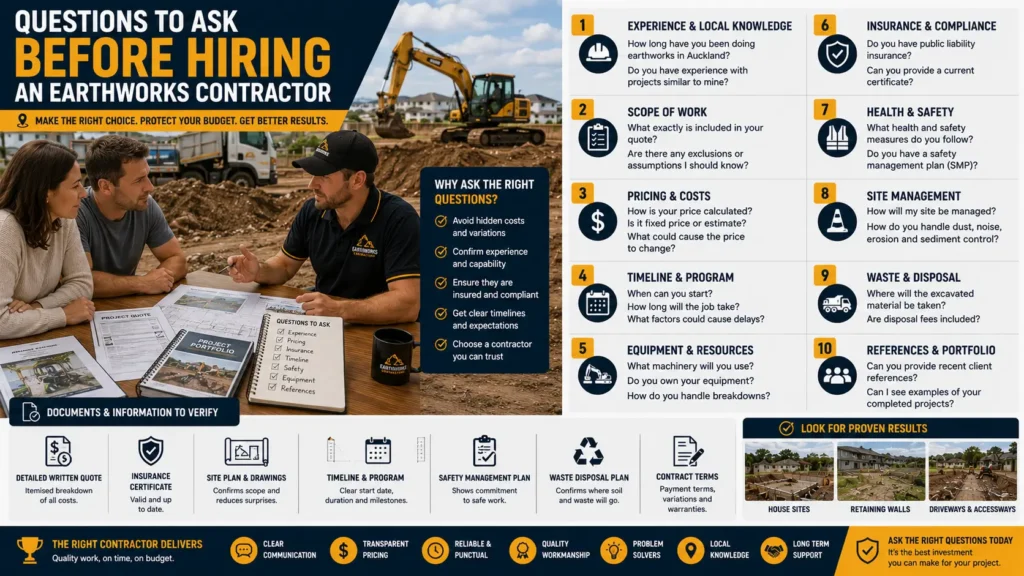
How Long Do Earthworks Projects Take?
The length of an earthworks project depends on much more than the size of the excavation. Site conditions, machinery access, weather, disposal requirements, and the complexity of the work all influence how quickly a project can be completed. Project duration also affects the total cost because labour, equipment hire, fuel, and transport are often calculated based on the time spent on-site. Understanding realistic timelines helps homeowners and developers plan their projects, coordinate other trades, and reduce the risk of unexpected expenses.
Small Residential Jobs
Small residential earthworks are often the quickest projects to complete, but the timeline still depends on site conditions and the type of work involved. Jobs such as minor site levelling, garden preparation, trenching for drainage, or removing a small amount of soil may only require one day if access is straightforward and the ground conditions are favourable.
Even relatively simple projects can take longer when machinery cannot easily reach the work area or when additional hand excavation is required around existing landscaping, fences, or underground services.
Typical factors that influence small residential project timelines include:
- Site access: Narrow driveways, gates, or limited working space may require smaller machinery that works more slowly.
- Ground conditions: Soft, rocky, or waterlogged soil often increases excavation time.
- Material removal: Projects requiring multiple truckloads of spoil generally take longer than jobs where material can remain on-site.
- Site preparation: Existing structures, vegetation, or buried utilities may require careful removal before excavation begins.
Driveway Excavation
Driveway excavation usually involves more than simply removing soil. The contractor must excavate to the correct depth, establish proper drainage, prepare a stable sub-base, and compact the surface before construction can continue.
A standard residential driveway may be completed within one to several days, depending on its size and the amount of earth that needs to be removed. Larger driveways or sloping sections generally require additional excavation, grading, and drainage work, increasing both the project duration and overall cost.
Several factors can extend driveway excavation:
- Existing surfaces: Removing old concrete or asphalt requires additional equipment and labour.
- Drainage installation: New drainage channels or stormwater connections add extra work before the driveway base can be completed.
- Restricted access: Tight urban sites often slow machinery movement and material transport.
- Compaction requirements: Proper compaction cannot be rushed because it helps prevent future settlement and cracking.
Foundation Preparation
Foundation excavation requires a high level of accuracy because it forms the base for the entire structure. Excavation must meet engineering plans and building requirements before concrete can be poured.
Although smaller residential foundations may be prepared within a few days, larger homes or projects with difficult site conditions often require additional time. Surveying, confirming finished levels, and coordinating with builders and engineers can also influence the schedule.
Foundation preparation may take longer because of:
- Engineering requirements: Excavation must follow approved plans with precise dimensions and depths.
- Building inspections: Some projects require inspections before construction progresses.
- Soil stability: Weak or unstable ground may require additional excavation or imported fill.
- Drainage work: Installing subsoil drainage before foundations are completed can increase the timeline.
Pool Excavation
Pool excavation is often completed surprisingly quickly once machinery arrives on-site, but the overall project usually involves much more than digging a hole. Excavation must achieve the correct dimensions while protecting nearby structures, underground services, and surrounding landscaping.
Simple installations on accessible sites may be excavated within one day, while more complex projects involving rock excavation, steep terrain, or restricted access may require several days.
Common factors affecting pool excavation include:
- Excavation volume: Larger pools naturally require more time to complete.
- Rock removal: Hard rock may require specialised equipment that slows progress.
- Access limitations: Smaller machinery may be necessary where access is restricted.
- Spoil removal: Transporting large amounts of excavated material off-site often adds significant time.
Large Cut-and-Fill Projects
Large cut-and-fill projects generally have the longest construction timelines because they involve both excavation and importing or relocating fill to create stable building platforms or reshape the land.
These projects often require careful planning, engineering oversight, compaction testing, drainage installation, and multiple stages of earthmoving before the site reaches its final design levels. Depending on the size of the development, work may continue for several weeks or even months.
The timeline is commonly affected by:
- Excavation volume: Larger quantities of material require additional machinery and truck movements.
- Compaction testing: Fill must often be placed and compacted in controlled layers before testing.
- Drainage systems: Stormwater and subsoil drainage are frequently installed during different construction stages.
- Project coordination: Earthworks must align with engineers, surveyors, builders, and utility contractors.
Common Causes of Earthworks Delays
Even well-planned projects can experience delays when unexpected conditions arise. Experienced contractors allow for reasonable contingencies, but some issues cannot be identified until excavation begins.
Weather Conditions
Weather is one of the most common reasons for delays, particularly during periods of heavy rainfall. Wet ground can become unstable, making it unsafe for machinery and reducing the quality of compaction.
Rain can also increase cleanup requirements, create muddy access routes, and delay inspections or concrete work that depends on completed earthworks.
Site Access
Limited access can slow almost every stage of an earthworks project. Narrow entrances, steep driveways, overhead power lines, neighbouring buildings, or confined urban sites may prevent larger machinery from operating efficiently.
Using smaller equipment often means more excavation cycles, additional labour, and longer project durations.
Material Disposal
Excavated soil does not always leave the site immediately. Contractors must coordinate truck availability, disposal facilities, transport routes, and tipping schedules. If disposal sites are busy or located a significant distance away, truck turnaround times increase, extending the overall project.
Disposal delays are more common on projects involving contaminated soil or large excavation volumes that require multiple truckloads.
Unexpected Ground Conditions
Ground conditions beneath the surface are not always visible before excavation starts. Contractors occasionally uncover buried concrete, large tree roots, underground tanks, rock formations, abandoned services, or contaminated material that requires additional work.
These discoveries often require changes to the excavation plan, specialised equipment, engineering advice, or approval from relevant authorities before work can continue safely.
- Hidden obstructions: Old foundations, buried rubble, or tree stumps can increase excavation time.
- Rock excavation: Breaking or removing rock requires specialised machinery and additional labour.
- Contaminated material: Testing, handling, and disposal procedures may significantly extend the project.
- Underground utilities: Existing water, gas, electrical, or communication services must be protected during excavation.
Project timelines play an important role in determining the total cost of earthworks. While smaller residential projects may be completed within a day or two, larger or more complex sites require additional planning, coordination, and contingency for changing conditions. Choosing an experienced contractor who carries out a thorough site assessment before work begins is one of the best ways to develop a realistic schedule, minimise delays, and keep the project moving efficiently.
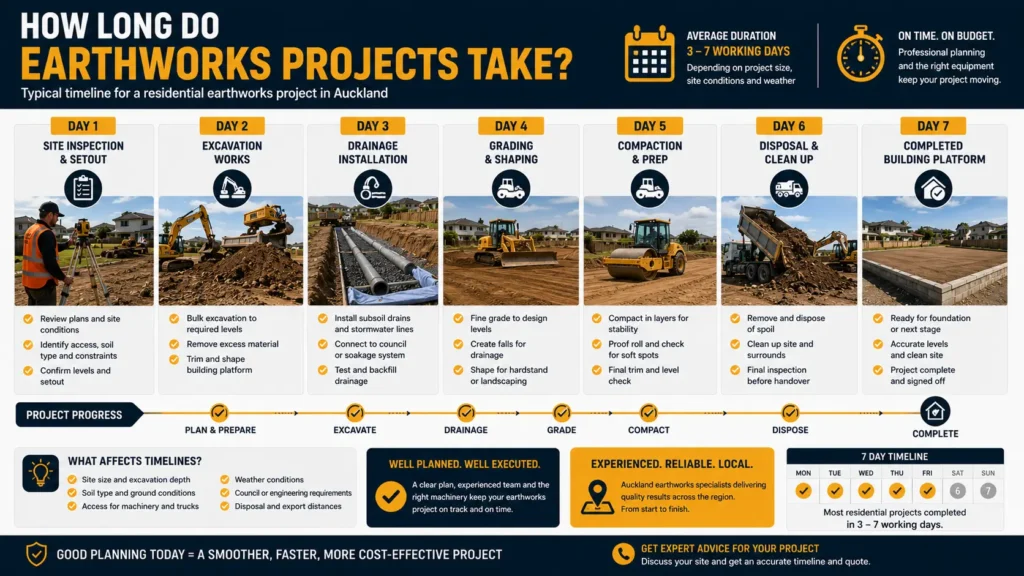
Is The Cheapest Earthworks Quote The Best Option?
Choosing the lowest-priced earthworks quote may seem like an easy way to save money, but the cheapest option is not always the most cost-effective. Earthworks projects involve much more than operating an excavator for a few hours. Site conditions, machinery, labour, drainage, disposal, and safety all influence the quality and success of the work. A quote that appears much lower than others may exclude important services or rely on assumptions that lead to additional charges later. Taking the time to compare what each contractor offers can help you avoid unexpected costs, project delays, and expensive rework.
Experience
An experienced earthworks contractor is more likely to identify site challenges before work begins. This includes recognising poor ground conditions, drainage issues, restricted access, or underground obstacles that may affect the project. Accurate planning from the start often results in fewer surprises and a smoother construction process.
When comparing contractors, consider more than the number of years they have been in business. Look for experience with projects that are similar to yours, whether that involves residential site preparation, retaining wall excavation, driveway construction, or foundation work.
- Relevant Projects: Ask whether the contractor has completed similar jobs with comparable site conditions.
- Problem Solving: Experienced contractors can often suggest practical solutions that reduce delays and unnecessary costs.
- Local Knowledge: Familiarity with Auckland’s varying soil types, weather conditions, and council requirements can improve project planning.
Scope Clarity
One of the biggest reasons for price differences is the level of detail included in the quote. A detailed quote clearly explains what work will be completed, while a vague quote may leave room for misunderstandings or additional charges.
A comprehensive scope of work allows you to compare contractors fairly because you are reviewing the same services rather than simply comparing the total price.
- Included Services: Confirm whether excavation, grading, compaction, cleanup, and disposal are included.
- Excluded Items: Ask about costs that are not included, such as imported fill, drainage materials, engineering, or council fees.
- Project Assumptions: Check whether the quote assumes normal soil conditions or allows for unexpected ground conditions.
Equipment Suitability
The right machinery can improve productivity, reduce site damage, and complete the work more efficiently. Using equipment that is too small may increase labour time, while machinery that is too large may struggle to access confined residential sites or damage surrounding landscaping.
A contractor should recommend machinery based on your property’s access, excavation depth, and overall project requirements rather than simply using the equipment they already own.
- Machine Selection: Ensure the proposed equipment matches the size and complexity of the project.
- Site Access: Confirm that machinery can safely enter and exit the property without causing unnecessary damage.
- Efficiency: Appropriate equipment can reduce operating hours and improve overall project quality.
Disposal Planning
Excavated material must often be transported away from the site, and disposal costs can represent a significant portion of the overall project budget. Some low-priced quotes exclude trucking, tipping fees, or multiple loads, resulting in unexpected expenses after work begins.
Understanding how excavated material will be managed helps prevent budget surprises.
- Waste Removal: Ask whether all excavated material will be removed from the site.
- Disposal Fees: Confirm whether landfill or clean-fill charges are included.
- Material Reuse: Discuss whether suitable soil can be reused elsewhere on the property to reduce disposal costs.
Safety
Earthworks involve heavy machinery, underground services, unstable ground, and changing site conditions. Safety should never be sacrificed to achieve a lower price.
Professional contractors invest in proper planning, operator training, equipment maintenance, and safe work procedures to reduce risks for workers, homeowners, and neighbouring properties.
- Utility Checks: Underground services should be identified before excavation begins.
- Site Protection: Safe work zones help protect people and surrounding structures.
- Equipment Maintenance: Well-maintained machinery reduces the likelihood of breakdowns and accidents.
Insurance
Insurance provides protection if unexpected events occur during the project. Contractors without adequate insurance may expose property owners to financial risks if damage or accidents happen on site.
Before accepting a quote, ask for confirmation that appropriate insurance policies are current.
- Public Liability Insurance: Helps protect against property damage or third-party claims.
- Worker Protection: Confirm that workers are covered while performing excavation work.
- Business Credibility: Professional contractors are generally willing to provide evidence of current insurance coverage.
Communication
Good communication often separates a smooth project from a stressful one. A contractor who explains the process clearly, answers questions promptly, and provides realistic expectations helps reduce uncertainty throughout the project.
Strong communication is particularly important if site conditions change after excavation begins.
- Project Updates: Regular communication helps you understand progress and any necessary changes.
- Clear Pricing: Contractors should explain how additional work will be approved before extra costs are incurred.
- Responsiveness: Questions and concerns should be addressed promptly throughout the project.
Reinstatement Quality
The excavation itself is only one part of a successful earthworks project. Once the required work is complete, the site often needs to be restored so that it is ready for the next stage of construction or landscaping.
Poor reinstatement can create uneven ground, drainage issues, settlement problems, or additional preparation work for other trades.
- Compaction: Proper compaction helps reduce future ground movement.
- Finished Levels: The site should be left at the agreed levels and grades.
- Site Cleanup: Excess material, debris, and waste should be removed before project completion.
- Preparation for Next Trades: Quality reinstatement makes it easier for builders, concreters, landscapers, or retaining wall installers to continue their work.
The lowest quote is only worthwhile if it delivers the quality, safety, and reliability your project requires. Comparing the contractor’s experience, the detail of the scope, equipment, disposal planning, insurance, communication, and the finished result will help you choose the option that provides the best long-term value rather than simply the lowest upfront price.
Get a clearer picture of your earthworks costs before committing to a contractor. Click through to arrange a site assessment and receive practical guidance based on your access, ground conditions, excavation volume, disposal needs, and project scope, so you can compare options with confidence and avoid unexpected charges.
References
- Auckland Council: Resource Consents
https://www.aucklandcouncil.govt.nz/building-and-consents/resource-consents/Pages/default.aspx - Auckland Council: When You Need a Regional Resource Consent
https://www.aucklandcouncil.govt.nz/en/building-and-consents/resource-consents/types-resource-consents/regional-resource-consents/regional-resource-consents.html - Auckland Council: Notify Us of Earthworks on Contaminated Land
https://www.aucklandcouncil.govt.nz/building-and-consents/resource-consents/types-resource-consents/earthworks/Pages/notify-earthworks-contaminated-land.aspx - Reliable Earthworks: How Much Does Excavation Cost in NZ?
https://reliableearthworks.co.nz/how-much-does-excavation-cost-nz/ - Bromley Group: How Much Do Earthworks Cost in Auckland? (2026 Guide)
https://www.bromleygroup.co.nz/blog/earthworks-cost-auckland
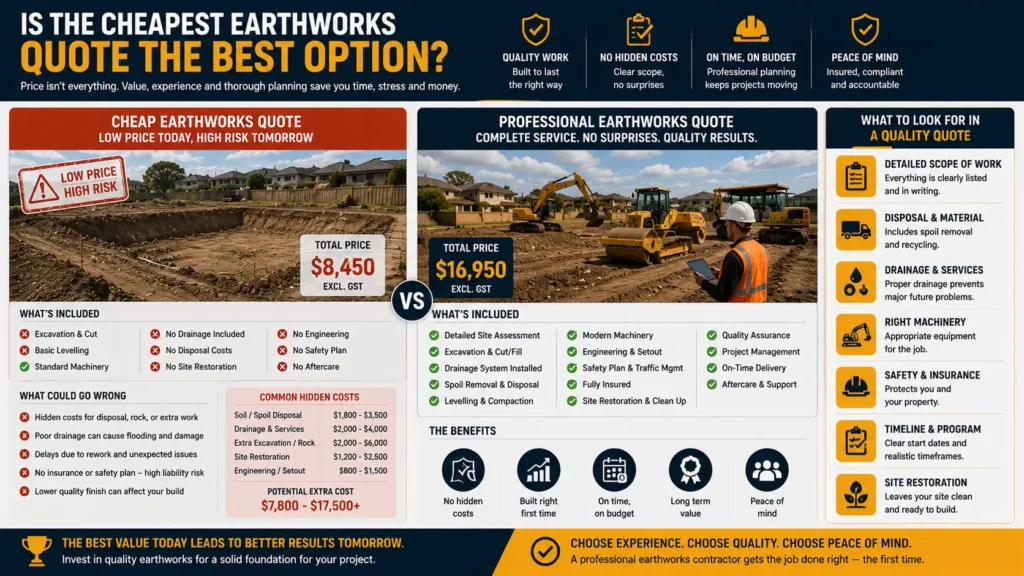
FAQs: about earthworks pricing In auckland
How much does earthworks cost in Auckland?
Earthworks pricing in Auckland varies depending on the size and complexity of the project. Factors such as excavation volume, soil conditions, machinery, access, drainage, and disposal requirements all influence the final cost. A site inspection is the most reliable way to receive an accurate quote.
What factors affect earthworks pricing the most?
The biggest pricing factors include site access, ground conditions, excavation depth, the amount of material being removed, machinery requirements, and disposal costs. Weather, drainage work, engineering requirements, and council regulations can also increase the overall project cost.
Do earthworks contractors charge by the hour or by the project?
Many contractors offer both hourly rates and fixed-price quotes depending on the project. Smaller jobs may be charged hourly, while larger residential or commercial projects are often quoted as a fixed price after inspecting the site and reviewing the project scope.
What is usually included in an earthworks quote?
A typical quote may include machinery, an experienced operator, excavation, site preparation, basic grading, loading excavated material, and site cleanup. Some quotes may exclude disposal fees, imported materials, drainage work, engineering, or council-related costs, so it is important to review the inclusions carefully.
Why do two earthworks quotes differ so much?
Contractors may use different machinery, include different services, or estimate varying amounts of labour and disposal costs. Site experience, project planning, insurance, equipment quality, and the level of detail provided in the quote can also affect pricing.
Can bad soil conditions increase earthworks costs?
Yes. Clay, rock, soft ground, groundwater, buried concrete, tree roots, or contaminated soil can increase excavation time and require additional machinery or disposal methods. These conditions are often difficult to identify until excavation begins.
Do I need council approval before starting earthworks in Auckland?
Some earthworks projects may require resource consent, building consent, or engineering approval depending on the scale of the work and the site’s location. Requirements can vary based on excavation volume, retaining walls, drainage changes, protected areas, and other local planning rules, so it is worth confirming the requirements before work starts.
How can I reduce the cost of an earthworks project?
Planning the project carefully before excavation begins can help reduce unnecessary costs. Finalising the design, improving site access, reusing suitable fill where appropriate, and combining related work into one project can improve efficiency and reduce overall expenses.
How long do most residential earthworks projects take?
Project duration depends on the amount of excavation, weather conditions, machinery access, and the complexity of the work. Small residential jobs may be completed within a day, while larger foundation, retaining wall, or site preparation projects can take several days or longer.
How do I choose the right earthworks contractor in Auckland?
Look for a contractor with experience in similar projects, appropriate insurance, positive customer reviews, and transparent pricing. A detailed written quote, clear communication, and a willingness to inspect the site before pricing are strong indicators of a reliable contractor.
Conclusion
Understanding what influences earthworks pricing in Auckland helps you plan your project with greater confidence and avoid unexpected costs. Factors such as site access, soil conditions, excavation volume, machinery requirements, drainage, material disposal, and council requirements can all affect the final price, which is why no two projects are exactly the same. A site-specific inspection gives a contractor the opportunity to assess these conditions, recommend the most suitable approach, and prepare a detailed, itemised quote that clearly outlines labour, machinery, disposal, materials, and any potential additional charges. Before accepting any proposal, take the time to confirm what is included, ask about drainage, access limitations, disposal fees, equipment to be used, and how unforeseen ground conditions will be managed. This simple step can help you compare quotes more accurately, reduce the risk of budget surprises, and ensure the work is completed efficiently. If you are planning an upcoming project, arranging a professional site assessment with an experienced Auckland earthworks contractor is one of the best ways to receive practical advice and an accurate quote tailored to your property and project requirements.

About the Author:
Mike Veail is a recognized digital marketing expert with over 6 years of experience in helping tradespeople and small businesses thrive online. A former quantity surveyor, Mike combines deep industry knowledge with hands-on expertise in SEO and Google Ads. His marketing strategies are tailored to the specific needs of the trades sector, helping businesses increase visibility and generate more leads through proven, ethical methods.
Mike has successfully partnered with numerous companies, establishing a track record of delivering measurable results. His work has been featured across various platforms that showcase his expertise in lead generation and online marketing for the trades sector.
Learn more about Mike's experience and services at https://theleadguy.online or follow him on social media: